
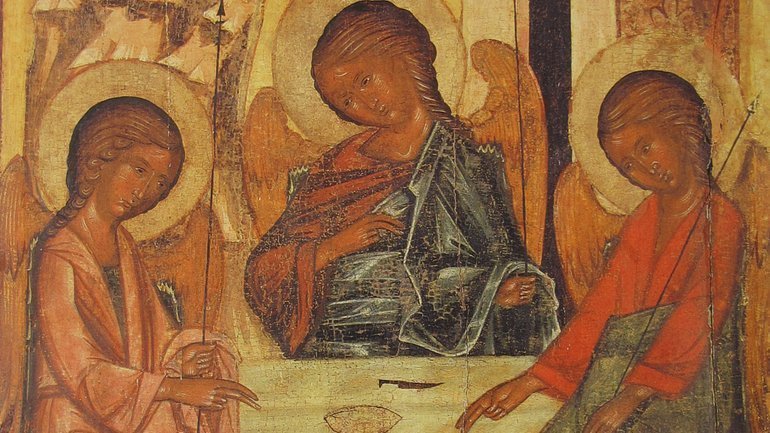
On the fortieth day after His glorious resurrection Jesus Christ ascended into heaven, and on the fiftieth day sent down the Holy Spirit upon the Apostles. For this reason, the fifty day period extending from Easter to the feast of the Descent of the Holy Spirit (Pentecost) is called the season of Pentecost. The feast of Pentecost or the Descent of the Holy Spirit bears the same name.
Great feasts are usually celebrated for several days after the feast itself. This continuation of the celebration is called the post-feast. The feast of the Pasch, the most prominent and solemn of all the feasts, has the longest post-festive period; it lasts until the feast of the Ascension of our Lord. During this period the services begin and end with the hymn of the Resurrection: “Christ is risen from the dead…” The Sundays of the Pentecost season are named according to the Gospel event of the day. The Gospel events and the services of those Sundays have for their purpose the glorification of the risen Christ and the strengthening of our faith in his divinity. During the period of Pentecost we celebrate three feasts that deserve our special attention: 1) the Sunday of Thomas, 2) the Mid-feast i.e., the “Middle Wednesday” or Mid-Pentecost (in Ukrainian “perepolovynennya” or “Half-Way” that is, the half-way mark or midway of the Pentecostal season or Mid-Pentecost) and 3) the Ascension of our Lord.
Thomas Sunday
The Sunday following Easter Sunday also has the following names:
The Sunday of St. Thomas from the Gospel event in which St. Thomas meets the risen Christ.
The Sunday of the Anti-pasch Anti-pasch is a Greek word signifying “in place of, instead of the Pasch”, for, to the Christians, this Sunday was, so to speak, a repetition of the feast of the Resurrection (Easter). In the Diary of a Pilgrimage written by Silvia of Acquitaine (4c) we read that on the eighth day after the Resurrection of Christ there were special celebrations in Jerusalem and that, on this day, the Gospel relating to the conversion of St. Thomas was read.
The New Sunday or The Sunday of Renewal or Renovation for it was on the first Sunday after the Resurrection that the celebration of the Pasch was, as it were, renewed. On this day Christ, himself, by appearing to His Apostles, renewed the joy of the Resurrection. “On this day,” says the Synaxary of Thomas Sunday, “the first Sunday after the Resurrection, we celebrate the renewal of Christ’s resurrection and the touching of His wounds by St. Thomas.”
White Sunday or Sunday “in white” – In ancient times the neophytes or the newly baptized, having received the Sacrament of Baptism on Great Saturday, wore a white garment throughout the entire Bright Week, and on the Sunday of St. Thomas they put aside this garment during a special ceremony. To this day the Western Church calls this Sunday “Sunday in White” or White Sunday.
The Leading Sunday or the First Sunday after Easter (the Pasch) Some authors derive this name from the fact that this Sunday is the leading Sunday, i.e., the first Sunday that continues the feast of the Pasch. Among our people there existed an old custom, on the Sunday of St. Thomas, of commemorating the dead with a special memorial repast and pray- ing for their souls at the cemetery.
The celebration of the eighth day after the Pasch as the conclusion of Bright Week, from earliest times, had been regarded as a separate feast. The theme of the services of this feast and of the week that follows is the Gospel event describing the apparition of Christ on the eighth day after His Resurrection and the moving scene of St. Thomas’ conversion and profession of faith. Regarding the significance of this feast, St. Gregory the Theologian (+389), in a homily on the Sunday of St. Thomas said: “The old law, which was established for a good purpose, honors the day of renewal, or rather, should we say, that with the day of renewal it honors new blessings. For, was not the first day of the resurrection, which occurred after the holy and glorious night, also a day of renewal? Why, then, do we give this name to today’s feast? That day (i.e. of the Resurrection) was a day of salvation, while this day is the commemoration of salvation. By its very nature, that day separates the burial and the resurrection, while this day is a day of an altogether new birth… Today we celebrate a genuine renewal, going from death to life. Therefore, cast off the old man and renew yourselves and live in newness of life.”
Our Church celebrates the memory of St. Thomas the Apostle on the 6th of October, whereas the Latin Church celebrates it on the 21st of December. About the apostolic work of St. Thomas, in a homily delivered on Thomas Sunday, St. John Chrysostom eulogizes St. Thomas thus: “Of all the other Apostles he was, at one time, the weakest in faith but, with God’s grace, he became more courageous and more untir- ing than the rest. He traversed almost the whole known world, preaching the word of God fearlessly to nations that were fierce, savage and bloodthirsty.” St. Thomas is believed to have died a martyr’s death for the Christian faith in India.
The Mid-Pentecost
On Wednesday after the Sunday of the Paralytic, which falls exactly in the middle of the Pentecost season, that period between Easter (the Resurrection) and the feast of the Pentecost or Descent of the Holy Spirit, the Eastern Church celebrates the feast of Mid-Pentecost which may mean “Half Way” because it is the half-way mark between the feast of Easter and the feast of the Pentecost, or “Middle Wednesday” since it falls on the Wednesday in the middle of the Pentecostal season. In Church Slavonic this Wednesday or feast is called “Prepolovynennya”; in English “Half Way” (midway) (or Mid-Pentecost). The Synaxary of that day explains the reason for the institution of this feast: “On the Wednesday of the Paralytic we celebrate the feast of Mid- Pentecost for the sake of honoring the two great feastdays Easter and the Pentecost. The feast of Mid-Pentecost unites and joins these two feasts.” The feast of Mid-Pentecost has an eight day post-feast which lasts to the Wednesday after the Sunday of the Samaritan Woman.
The reason for this feast is based on the Gospel of St. John in which it is written: “When, however, the feast (i.e., the feast of Tabernacles) was already half over, Jesus went up in- to the temple and began to teach.” (John 7,14) There he spoke of his divine mission and of miraculous water: “My teaching is not my own, but his who sent me… If anyone thirst, let him come to me and drink. Whoever believes in me, as Scripture says, ‘from within him there shall flow rivers of living waters. He said this, however, of the Spirit whom they, who believed in him, were to receive.” (John 7,16; 37-39)
This feast was already observed at the time of St. John Chrysostom (+407). The liturgy or service for the feast of Mid-Pentecost was composed by Anatolius, Patriarch of Constan- tinople (+458), St. Andrew of Crete, (+740), St. John Damascene (1749) and St. Theophane the Confessor (1817).
The feast of the Mid-Pentecost aims to strengthen our faith in the risen Christ, to inspire us to observe the commandments of God and to predispose us for the feast of the Ascension of our Lord and the Descent of the Holy Spirit. In the Matins service of that day at the Sticheras of Praises we sing: “Brethren, having been enlightened by the resurrection of the Saviour Jesus Christ, and having reached the halfway mark of the feast of the Lord, let us sincerely observe the commandments of God, so that we may become worthy to celebrate the Ascension and receive the coming of the Holy Spirit.”
The Ascension of Our Lord
The feast of the Lord’s Ascension always falls on a Thurs- day, on the fortieth day after Christ’s resurrection. This is one of the principal feastdays of our Lord and therefore, has a post-feast of nine days. It celebrates the memory of Christ’s Ascension into heaven and underscores its significance for Christ and for us. St. John Chrysostom, in his homily on the Ascension says: “Today the human race is completely reconciled with God. The ancient battle and enmity have disappeared. We, who were unworthy to live even on earth – are now lifted up to heaven. Today we become heirs to the kingdom of heaven, we, who do not even deserve earth, we ascend to heaven and inherit the throne of the King and Lord. Human nature, against which the cherubim guarded paradise, is now raised up above all the cherubim.” Sources of the first three centuries do not speak of this
feast. Not even the writer Origen (+251) mentions it, although he lists the Christian feasts in the eighth book of his work
“Against Celsus”. Liturgical experts are of the opinion that in the first three centuries the celebration of this feast was combined with that of the feast of the Descent of the Holy Spirit (Pentecost). Silvia Egeria does not call this feast the “Ascension”, but only “the fortieth day after the resurrection of Christ.”
In the fourth century the feast of the Lord’s Ascension became a universal feast, celebrated everywhere. The Historian Socrates (†c.440) calls it a “general feast”. (History of the Church, 7,26)
The feast of the Ascension was highly extolled in the sermons of St. John Chrysostom, St. Gregory of Nyssa, St. Epiphany of Cyprus, Leo the Great and others. In the fourth century, Queen Helena erected a church at the place of Christ’s Ascension in honor of this feast.
The spirit of the services of this feast, as a whole, is uplifting and joyful. The Church rejoices at the glory of Christ (God and Man), who is now seated at the right hand of the Father. He ascended into heaven, in order to send us the Comforter the Holy Spirit and to “prepare a place for us,” (John 14,2) as he promised.
“The Lord ascended into heaven,” we sing in the first stichera of the Great Vespers service of the feast of the Ascension, “in order to send the Comforter to the world. Therefore, heaven prepared a throne for him and the clouds assisted him in his ascent. The angels wonder as they see a man more exalted than they. The Father receives into his bosom him, who is eternally with him. The Holy Spirit commands all his angels:
Lift up your gates’ lintels, O princes; all you nations clap ” your hands; for Christ has ascended whither He was before.”
