Thursday, June 11, 2026
St Luke Ukrainian Greek Catholic Church

Cody

Glory to Jesus Christ!

We are now in the season of “Sundays after Pentecost.” This means we have concluded a long liturgical cycle: beginning with Lent which prepares us for Pascha, which we then celebrate for 40 days, after which we have the Ascension of our Lord, then Pentecost, and All Saints. If one looks closely at this series of commemorations and feasts, there can be seen an internal unity, a purposeful progression given by the Church to drive home the meaning of our lives and the relevance of God’s self-revelation to us today.

On Monday of the first week of Lent we begin hearing daily readings from the book of Genesis. On this very first day of the Fast weDivine Liturgy: Partking in the Eternal Liturgy in Heaven hear the very first passage of the Bible, Genesis 1:1: “In the beginning, God created the heavens and the earth.” This is where the whole story of our salvation begins. And, of course, when you use the word “salvation,” the question naturally arises, “salvation from what?” Well, that is exactly the point of these daily readings. The first four days of Lent we hear of God’s wondrous creation of the world. He creates the earth, sun, moon, and stars, and every living creature to walk upon the land and to fill the skies and the watery depths. He plants a garden, a paradise of delights full of “every tree, beautiful to the eye and good for food.” Everything that He creates, God declares to be “good.” As the climax of His wondrous creation, God creates man in His image and likeness, endowed with speech and reason, breathes His divine life into him, giving him a living soul, and places him in the garden of paradise. God pronounces this culmination of His creation to be “very good.” In this garden Adam was to walk with God in the cool of the day, sharing God’s life and the graces poured out upon him. Adam is clothed with the light of God’s grace and life. This was the divine plan for each of us. This is what we were created for.
Yet, on Friday of the first week we hear of a tragedy: Adam betrays God, disobeys His command, and so doing cuts himself off from the God-created paradise, from God’s gifts of grace, and, indeed, from God Himself. Adam and Eve are expelled from the Garden, and are no longer to be partakers of the Tree of Life. As a sign of the death they have brought upon themselves they are stripped of their garments of God’s light with which they were clothed in Paradise, and instead are clothed in the skins of dead animals: instead of being clothed with Life, they are clothed with death.

The Sunday before Lent (the day before we begin hearing these readings from Genesis) is the Commemoration of Adam and Eve’s Expulsion from Paradise, because Adam and Eve’s disobedience and consequent fall are the essential starting point for the story of salvation, the why behind it all. This is the answer to that question: “salvation from what?“. God has granted us salvation from the fall of Adam: from the cutting one’s self off from God and the life and grace that He freely offers us; from losing the heavenly paradise for which we were created. Salvation is the renewal of being partakers in God’s divine life.  From here on, the story is about God’s work of salvation. 

So as Lent goes on we hear more from the book of Genesis as God begins to enact His plan of salvation to bring us back to Paradise. During Holy Week we hear the story of the Exodus from Egypt: the people of Israel had sold themselves not only into physical slavery, but into spiritual slavery, forsaking the God who created them and worshiping the pagan idols of Egypt. Yet God did not forsake them, and brought them out of Egypt, striking their Egyptian captors, but by way of the blood of the lamb, passing over the Israelites and allowing them to flee.

The Lord’s Passover in the Book of Exodus is fulfilled in the New Testament, when Jesus Christ, the Lamb of God, is slain and Death, the captor of old, is struck dead, allowing mankind to escape his grasp. This is the Lord’s true Passover (hence why we call it “Pascha!”). During Paschal time we sing over and over: “Christ is risen from the dead, trampling down death by death, and upon those in the tombs bestowing life!” We are once again made partakers of God’s life! The old enemy has been destroyed, and we have been restored to paradise!
 

After His resurrection, our Lord Jesus remained with His disciples for forty days, walking and talking and eating with them. Though in His resurrected body and able to go through closed doors, these appearance were all quite normal, unlike the appearance at the Transfiguration. Yet on the 40th day, Christ is once again seen glorified, and He ascended to the Father. He ascended so that He could send the Spirit, the “Paraclete.” And yet, in ascending, the Lord Jesus did not depart from us, but rather remains present in His Church in an even more intense way. Pope St. Leo the Great says that Christ ascended into the Sacraments, and in them we are made partakers of Christ Himself in a way not possible before: through Holy Baptism we are made members of His body and partakers of His death and resurrection; through Holy Chrismation He breathes into us His divine life; in Holy Communion we are fed with His Body and Blood; in Holy Confession and Anointing we are given His divine reconciliation and healing; in Holy Matrimony and through the Laying-on-of-Hands we reign with Him and work for the sanctification of the world.

All this is made possible through the work of the Holy Spirit. At the descent of the Holy Spirit on Pentecost (the 50th day) the Lord’s disciples and apostles were heard in many languages by those assembled for the feast. They then went forth to “make disciples of all Kneeling Vespers: Praying for the coming of the Holy Spirit on Pentecost nations, baptizing them in the name of the Father and of the Son and of the Holy Spirit, and teaching them to obey everything that [Christ] commanded” (Matt 28:19-20). The restoration of Adam achieved through Christ’s death and resurrection was not just for the disciples and the people of Jerusalem, but for the whole world. The gift of languages was given to the disciples for the sake of their preaching in the far corners of the world, to unite the peoples of the world and give them the Good News of our reconciliation and salvation. Everyone is once again to be made partakers in God’s divine life.
Throughout the Byzantine liturgical year, there are many instances in which, after a great feast there is a lesser commemoration of a secondary figure or group of figures connected with that greater feast. This is called a “synaxis” (a “gathering together”). For example, on February 2nd we celebrate the Lord’s encounter with the Righteous Simeon and the Prophetess Anna in the temple, and on February 3rd the Synaxis of Righetous Simeon and Anna. Likewise, the Sunday after Christmas is the commemoration of His foster-father Joseph, David, His ancestor, and James, His brother.

With this perspective, you can see how the Sunday after Pentecost, the feast of All Saints, is a synaxis-type feast, for through the work of the Spirit and the preaching of the apostles, countless numbers of people have come to know the Word of God and have entered His Kingdom in Heaven. As we cannot commemorate every saint individually, and indeed there are many who are unknown to us, we have this general commemoration of All Saints, the fruit of the coming of the Holy Spirit.

Similarly, the Second Sunday after Pentecost is held as a commemoration of all local saints. In our Ukrainian Catholic Church this is the Sunday of All Saints of the land of Rus’-Ukraine, and in other places it is a commemoration of all the saints of that place (Greece, Athos, North America, etc). This is extremely important to understand: this is not a cultural or ethnic celebration of “our saints.” Rather, this commemoration of local saints is a second synactic extension of Pentecost, tying the descent of the Holy Spirit with the here-and-now of our lives. In commemorating all local saints, the Church is emphasizing that the Faith was given by Christ to His disciples, and through the Holy Spirit it has been passed down through the centuries to us, to each of us in that far corner of the world in which we live (This is what it means to be an Apostolic Church!). The commemoration of local saints is a reminder that the ground we walk on is holy ground, for there have been saints here in this very place! We have no excuse: the Faith is not just something for other people in other places to live out. Becoming holy, being filled with the Spirit, and coming into evermore perfect communion with God is imminently possible, even for us here, in this place. We are called to be saints here and now. And, God-willing (and He does will it!), we will be numbered among those local saints some day!
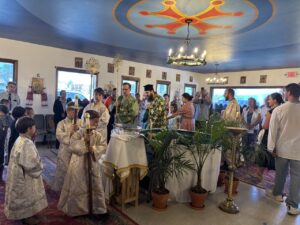
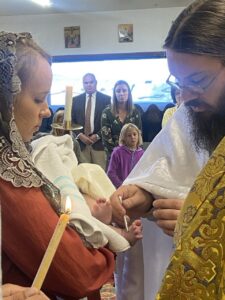
Baptism: another soul filled with God's life and claimed for the Kingdom of God


With these final commemorations of All Saints, we see the conclusion of the cycle, which really is the entire story of salvation: from the fall of Adam through the Old Testament to our Lord’s incarnation, crucifixion, resurrection, ascension, and sending of the Holy Spirit, resulting in the sanctification of people in every age and in every place in the world. We also see that this post-Pentecost period is not just a portion of the liturgical year, but the grace-filled age which stretches from the original Pentecost 2000 years ago until the glorious Second Coming of Christ.


So, as we live out our 21st-century lives here in Wyoming or wherever you are reading this, don’t forget that “the kingdom of God is at hand” (Matt 3:2), and we are invited to be members of it. We are living in the age of the Holy Spirit, Whom we have received. We have heard the words of the Divine Gospel: “Death is overthrown! Christ God is risen, granting the world great mercy!” (Resurrectional troparion, Tone 4) Filled with the Spirit, let us sing with the apostles and all the saints of the whole world: “O Christ our God, You have demolished the brazen gates of Hades. You have broken asunder the bonds of death, and lifted up the fallen human race. Therefore, we cry out with one accord: O Lord, who arose from the dead, glory to You!” (Resurrectional sticheron, Tone 4)

236
0 FacebookTwitterPinterestWhatsappTelegramSkypeViberEmail

We’ve begun a major church beautification project, and you can get involved and help! As announced in our previous post, we have been donated a pair of beautiful Holy Doors. To go with this, we will be building an iconostasis, which separates the nave from the Sanctuary and reveals the fullness of the kingdom of God, “but at the same time indicates that we must continue journeying to the kingdom” (Christ our Pascha, 340). In order to have something to support the iconostasis, we will also be building some walls that will simultaneously create small rooms to serve as sacristies. We will also be adorning our church with icons, lamps, and an altar curtain.

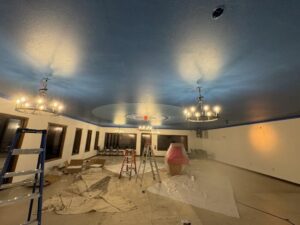
We’ve already begun working on the church, and have removed the old and barely-functional flourescent lighting, and are currently painting the ceiling. When the painting is done and chandeliers are hung, we will begin building our sanctuary! We’re all very excited about these developments. 

You can help us by getting involved and financially supporting our renovations and church beautification. We’ve already done a lot, but there’s a long way to go to meet our goal. Your donation, even a small one, will make a real concrete difference to our small mission community. In addition, a contribution to our church is a beautiful way to commemorate your departed loved ones.

You can contribute via this link.

I thank God for all our parishioners and supporters, and we pray for our benefactors and their intentions at every Divine Liturgy. May God richly bless you all!


In Christ,

Fr. Philip

https://www.zeffy.com/en-US/fundraising/46dbe6e1-ed9c-48c6-81f5-36899c41dced?fbclid=IwY2xjawGy8dxleHRuA2FlbQIxMAABHQJpxQK5n90bhEUX8GFq4TMwkI_5lvMF3yF-CTw7RKdL_lJsqYEjJNx-pA_aem_5rCiIxENP7bpPrQVXH5ajw

406
0 FacebookTwitterPinterestWhatsappTelegramSkypeViberEmail

Glory to Jesus Christ!

Dear friends and parishioners of St Luke Church,

 
I would like to share some updates with you about what’s been going on here at St Luke the last couple months.
 
First of all, for those of you who don’t know me, I am Fr. Philip Gilbert, and I the newly-assigned priest at St Luke, taking over from Fr. Roman. I split my seminary studies between Washington, DC and  Lviv, Ukraine, the latter being where I got my master’s degree at Ukrainian Catholic University, met my wife Christine, got married and was ordained a deacon. When the war began in 2022, we moved to the States, and from then until my being ordained a priest in May of this year, we have been living in Kansas. We arrived in Cody at the beginning of September. We’ve mostly unpacked and settled in, and we are very much liking living in Wyoming! We already feel at home here. And we have been keeping busy! 

In addition to everything at St. Luke in Cody, I have been down to the new community that has formed in Casper (which is only a short three hour drive away) twice now and served some beautiful Divine Liturgies there. The community is enthusiastic and welcoming and has a lot of potential. I look forward to seeing how it grows and develops as time goes on. Here’s a picture taken before Liturgy in our temporary space in Casper:
I am proud of our singers, who have been working on some new pieces to enrich our liturgical services. We’ve recently begun singing a new version of the Great Doxology from Matins (which you can listen to here) as well as a couple other things. Keep an eye out for more recordings in the future!
 
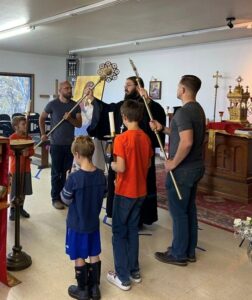
In late September we had a Saturday breakfast and liturgical training with the altar servers’ guild (picture below). It’s such a blessing to have such a great team assisting me at the altar. Not long after that we had a baptism (also below), which was my first as a priest, and it was absolutely beautiful.
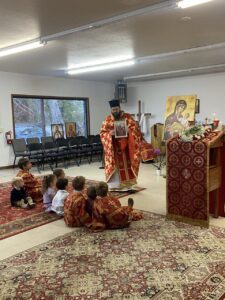
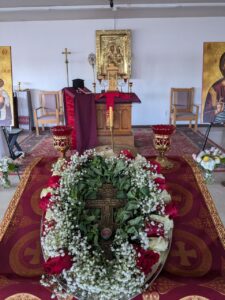
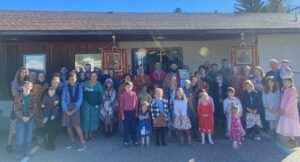
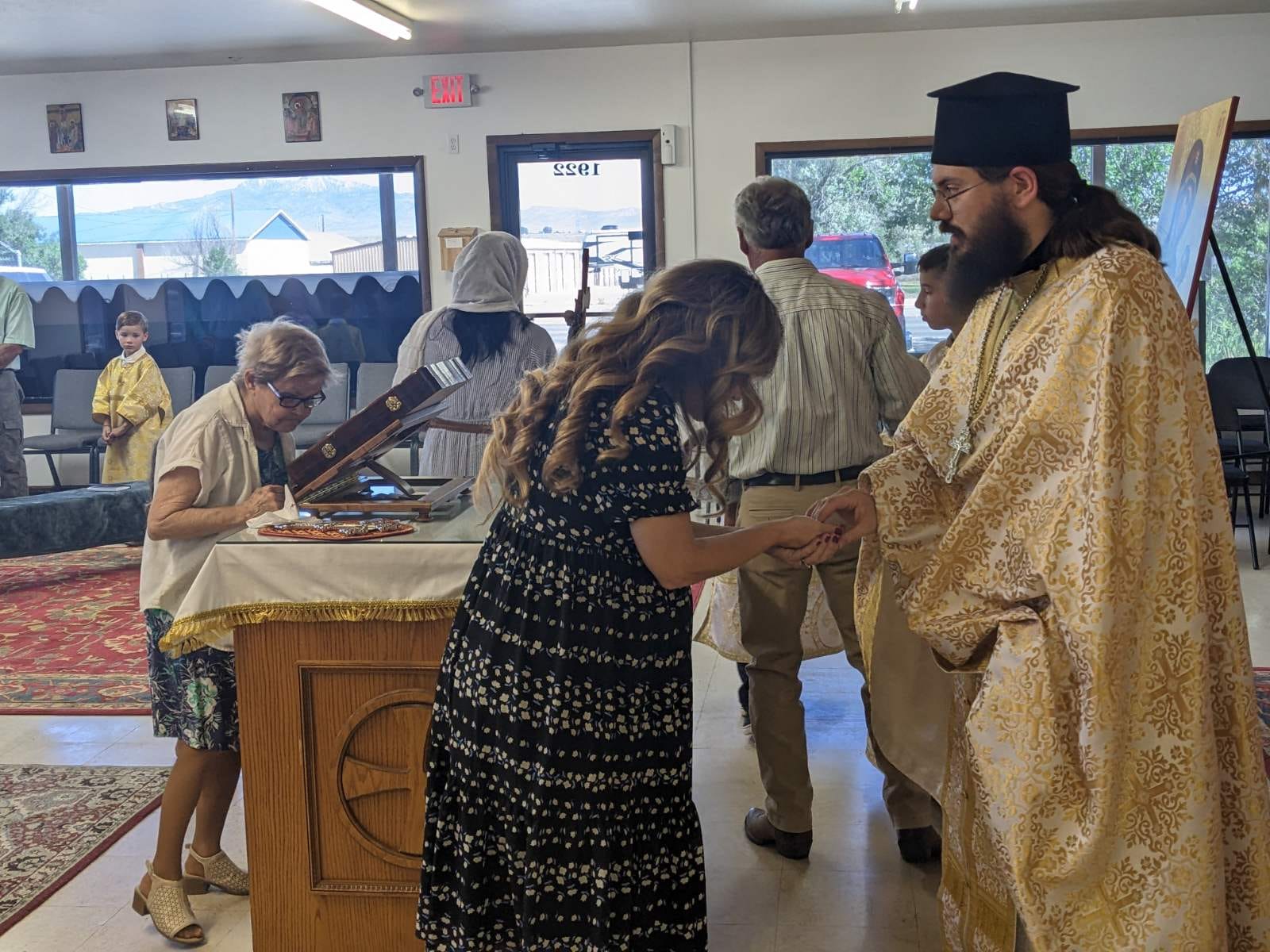
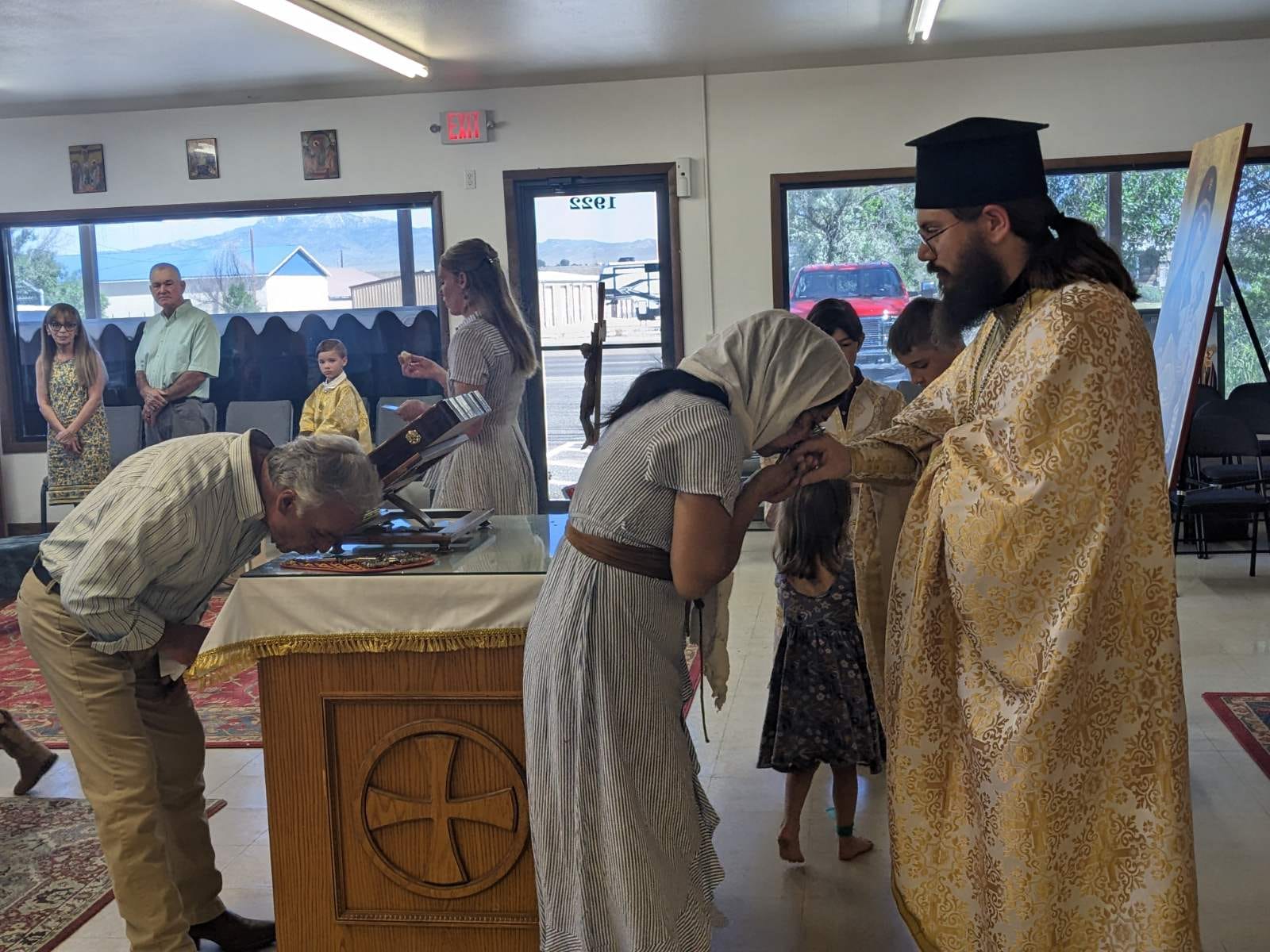
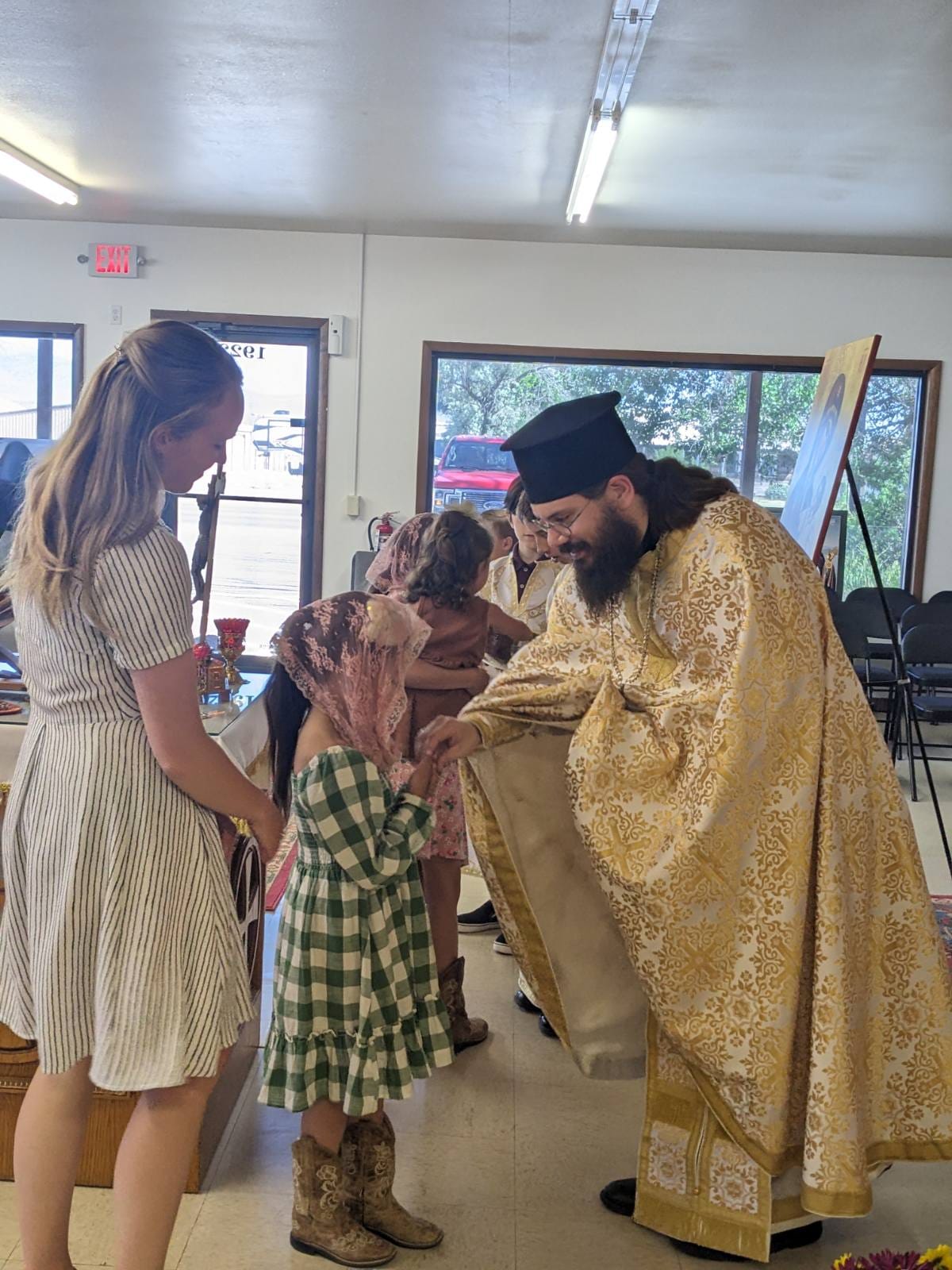
We’ve had festal Great Vespers with Lytia for a number of great feasts, including  Exaltation of the Holy Cross (with the veneration of the holy relic, shown above), and the Nativity and Protection of the Mother of God. We also celebrated our patronal feast with a wonderful celebration of Vespers with lytia on the eve of the feast, and on Sunday we had a festal procession around the church building and a celebratory parish luncheon afterwards. The church was beautifully decorated, our relic of St Luke was placed out for veneration, and we were honored to have a number of guests celebrating with us. Everyone had a good time. You can see some highlights of the feast here, and our parish photo from that day is here:
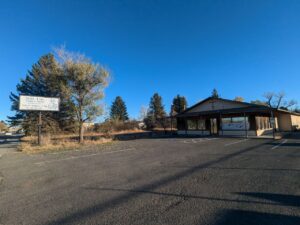
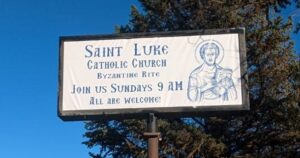
We’ve been doing some improvement work around the church: we’ve had some trees and brush removed, including some rather dangerous dead trees that were threatening our parking lot. We’ve also put up a sign on the roadside billboard, so that the local traffic will know where we are located. 
We are also beginning some improvements to our liturgical space. In preparation for our patronal feast, we sealed off the window which was between the church and the kitchen, thus eliminating distracting noise and smells in an attempt to keep the church a prayerful environment. Likewise, we’ve put in a doorway (with the door itself soon to follow) in the corridor leading from the church into our dining room so that those socializing in the hall after services won’t disturb those who have remained in the church to pray. 
 
Our next projects,which I am very excited about, will involve putting up some walls to create sacristies, and the construction and installation of an iconostasis. The iconostasis, or “icon screen”, is one of the most essential parts of Byzantine church architecture. It separates the nave of the church from the sanctuary, not only serving the practical purpose of keeping the holy things safe from those who might disturb them (for example, quick-footed children, of which we have many), but reveals to us the fullness of the kingdom of God and “at the same time indicates that we must continue journeying to the kingdom” (Christ our Pascha, 340). The iconostasis, as indicated by the name, contains a number of icons, reminding us that when standing in the church, we are standing in the presence of the saints and angels and the entire Mystical Body of Christ, and it is through the intercession of the saints that we may enter the Kingdom of Heaven. In the center of the iconostasis there is to be a pair of doors, known as the “holy doors”, or “beautiful gates”. It is through these doors that the Gospel is brought out to be proclaimed, and the Eucharist is brought out to the people. These doors are always adorned with the icon of the Annunciation: for it was through the annunciation to the Virgin and the incarnation of the Word that our salvation was brought about and the kingdom of Heaven was opened to us.
 
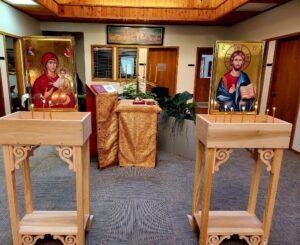
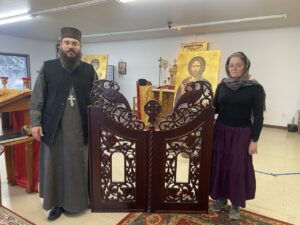
We are going to start this project as soon as possible, since just yesterday we received a pair of beautifully carved holy doors, shipped to us all the way from Poland (see picture below). This provides you with an opportunity: We are looking for someone to donate $2500 for the purchase and installation of these beautiful doors, which will enrich our liturgical life and bring great beauty to our church. We pray for our benefactors and their intentions at every Divine Liturgy, so this is a beautiful way to commend your beloved departed to the Lord and the prayer of the Church. If you would like to donate these doors to our church, perhaps in memory of your deceased parents or other loved ones, please contact me.  [Update: These doors have already been donated, but there will be more similar oportunities. Please contact me if you are interested!]
If you would like to  contribute to the beautification of our church in a smaller amount or a more general way,  you may do so here.


May God richly bless you all! 


In Christ,
Fr. Philip
173
0 FacebookTwitterPinterestWhatsappTelegramSkypeViberEmail

«The Gospel is the Power of God to Salvation for Everyone who Believes» (Rm 1:16): Pastoral Letter of the Synod of Bishops of the Ukrainian Greek-Catholic Church 2024 to the Clergy, Religious and Lay Faithful of the UGCC.

«THE GOSPEL IS THE POWER OF GOD TO SALVATION
FOR EVERYONE WHO BELIEVES» (Rm 1:16)

Pastoral Letter of the Synod of Bishops
of the Ukrainian Greek-Catholic Church 2024
To the Clergy, Religious and Lay Faithful of the UGCC

While they were talking and discussing together,
Jesus himself drew near and went with them
(Lk 24:15).

Dear Brothers and Sisters in Christ!

We, the bishops of the Ukrainian Greek-Catholic Church from Ukraine and various parts of the world, have gathered at the feet of the miraculous icon of the Mother of God in Zarvanytsya from July 2 to 12 for the annual Synod. For the first time since the beginning of the full-scale invasion, all the bishops of our Church came to Zarvanytsya, to be together with their faithful, to share their pain and trepidations. Every day we offered up prayers for a just peace and an end to a war that was criminally and insidiously initiated by Russia against our people and a free Ukraine. In the days when our Synod was held, Russian brutality crossed another line: in order to break our will to resist, the enemy attacked the most vulnerable — sick children from all across the country being treated in the central children’s hospital in Kyiv. But despite this shameful plan, we witnessed solidarity and kindness—thousands of people sifted through the ruins of destroyed buildings, sheltered the injured, and within a few hours collected funds for the reconstruction of the hospital. In this tragedy, we saw all a person is capable of—the most terrible and the most magnificent. We saw that at the core of our will to resist there is humanity and empathy.

Despite the terrible context, we sought answers—on how to preach the Gospel of Christ in this time of trials and suffering, on how to evangelize, how to be messengers of hope for our neighbors and the outside world. This was the main topic of our Synod.

Our people continues its pilgrimage to full freedom from enslavement by the empire of evil which, first in the form of tsarist and communist Russia, and now in the form of Putin’s criminal regime, denied and continues to deny the very right of Ukrainians to exist and to build their own existence in the light of Divine truth and Divine law. We do not forget and do not let the world forget that Russian occupation brings death and crimes against humanity. What we have is recurring genocide. What we have are recurrent prohibitions of our Church which nonetheless rises again and again with its people.

In the suffering of Ukrainians, the earthly journey of our Savior is revealed once again, a Savior whom enemies hated without cause (cf. Jn 15:25), betrayed out of envy (cf. Mk 15:10), tortured with fierce malice (cf. Jn 19:3) and mercilessly killed on the cross (Mk 10:34). Foretelling his passion, Jesus Christ gave his disciples an infallible promise of resurrection: «The Son of Man will be delivered over to the chief priests and the scribes, and they will condemn him to death and deliver him over to the Gentiles. And they will mock him and spit on him, and flog him and kill him. And after three days he will rise» (Mk 10:33–34). When the apostles heard these words, they hardly realized what they would have to go through, and perhaps they thought more about the promise of the Kingdom than about the Teacher’s death. Thus, on the day of Good Friday, it seemed to each of them that it was already the end. Even after initial reports of the Resurrection, the two disciples on the road to Emmaus are distressed, they are assailed by numerous doubts and questions.

In the terrible conditions of war, within Ukrainian society there are also many doubts and questions which we, pastors, cannot ignore, even though we do not have an exhaustive answer to them. Often the prayer of our people resembles the cry of the psalmist who experiences loneliness and injustice.

We must discover for ourselves the presence of Christ in our pilgrimage as the two disciples from Emmaus experienced (cf. Lk 24:13–23). Confused and tired, they allowed their hearts to be enlightened and warmed by the word of God that came from the mouth of the Risen One, and then they recognized Him in the breaking of bread. In the same way, we, as a Church and a people, are called to be enlightened by God’s word of hope, truth, and life, and to strengthen ourselves with heavenly food — the most holy Body and Blood of our Savior. In them, the Lord gives us the pledge of victory and eternal life over which death no longer has any power because we carry within us the deposit of resurrection according to Christ’s infallible promise: «Whoever eats my flesh and drinks my blood has eternal life, and I will raise him up on the last day» (Jn 6:54).

Beloved in Christ, let us be strengthened by the Word of God, for in it is the Spirit and life (cf. Jn 6:63), the source and pledge of our hope! When we hear sirens, when streams of disheartening news come at us from everywhere, when despondency, fear, and hopelessness surround us, let us take the Holy Scriptures in our hands, pour out our sorrows and pain before God, and together look for light and the necessary strength. After all, St. Paul assures us, and the thousand-year experience of our people and our unyielding martyr-Church confirms that «the Gospel is the power of God to salvation for everyone who believes» (Rm 1:16).

The power of God, like the life-giving breath of the risen Savior, revives us every time the Church proclaims the Gospel of Christ to each person today. This proclamation (kerygma) vividly makes the Lord’s action present in our daily reality. This living word of the Good News about Christ’s Resurrection, God’s love for us, the forgiveness of sins, and the communion of eternal life conveys to everyone who believes the very Source of our hope and the power of Christian perseverance. It [this proclamation] informs us not of past works of God, but of the fact that He acts in relation to each of us personally this very day by the power and action of the Holy Spirit. When the enemy sows death and wants to imprison us in his kingdom of hopelessness and despair, the Church of Christ in its proclamation brings to each person who believes life and resurrection, hope of salvation, and leads them to communion of the Holy Mysteries. That is why spreading this Word of the Gospel into all dimensions of our personal and social life, so that its power might permeate contemporary culture, and its light transfigure the way of human thinking and acting (evangelization), and transmitting the faith to all who have not yet come to know Christ, is the core mission of all His disciples — our contemporaries. It is about us, especially those who are called to serve the Word of God, that St. Paul the Apostle speaks: «For if I preach the gospel, that gives me no ground for boasting. For necessity is laid upon me. Woe to me if I do not preach the gospel!» (1 Cor 9:16).

We call on all the faithful of our Church to read God’s Word daily and meditate on it in parish bible apostolate communities. Let our families be the first place where the treasure of faith is passed on to new generations of Christians, where praying together and the reading of the Holy Scriptures are practiced, and where different generations strengthen one another through a witness of faith and through patient and faithful love. However, let us remember that God’s Word always leads to the partaking of the Holy Mysteries and is fulfilled in the Liturgy of Christ’s Church in the same way that the hearts of the disciples burned on the way to Emmaus, when Jesus spoke to them on the way, but they could only recognize Him in the breaking of bread—in partaking of His life and resurrection in the Mystery of the Eucharist (Lk 24:35).

The consequences of Russian shelling are obvious, in particular in the form of Ukrainians being killed or maimed. However, there are wounds on the body of our people that we hear less about in the daily news. We speak of the burden that has fallen on Ukrainian families who bury their dead, care for the wounded, search for the missing, and share the post-traumatic syndrome of veterans. Statistics of divorces, of broken families, of family members scattered around the world—all represent threats to our society. Therefore, we continue striving to give special pastoral attention to our families. We call on the parish clergy and the entire community of the faithful to care for families who have lost loved ones, and for everyone who is suffering near us, who feels alone or abandoned. Here it is appropriate to recall the words of Pope Benedict XVI who emphasized: «The Church is God’s family in the world. In this family no one ought to go without the necessities of life… The parable of the Good Samaritan remains as a standard which imposes universal love towards the needy whom we encounter „by chance’ (cf. Lk 10:31), whoever they may be. Without in any way detracting from this commandment of universal love, the Church also has a specific responsibility: within the ecclesial family no member should suffer through being in need“ (Encyclical Deus caritas est, 25).

Having deep wounds, which the war has already inflicted on us and inflicts each day on our soul and body, «let us then with confidence draw near to the throne of grace, that we may receive mercy and find grace for help in time of need» (cf. Heb 4:16). In particular, let us often approach the Sacrament of Confession and not hesitate to bring all our wounds, ailments, and diseases to the merciful Lord — the Physician of souls and bodies — in the Sacrament of Anointing. It is in these Sacraments, which the Church calls the Sacraments of healing, that our Savior and Lord wants to embrace us with his merciful love and pour out the healing balm of his grace on our aching souls and hearts. Let us allow Him to do it! Let us allow Him to heal us daily, overcoming the effects of war with the power of God’s love, and restoring us to new hope and new life.

This new life is the life of the crucified and risen Christ in us, which reveals itself to the world in our acts of merciful and compassionate love. Therefore, in the midst of all the trials and sufferings of our days, let us not give up, but let us continue to do good to everyone, and above all to «those who are of the household of faith» (cf. Gal 6:10), to our suffering brothers and sisters in our native lands, in Ukraine. We repeat the call from our pastoral letter of last year, which should remain a guide for us in our daily decisions and actions: «Do not be overcome by evil, but overcome evil with good!» (Rm 12:21). If each of us does at least one concrete good deed every day, we will steadily step by step bring closer the victory of God’s truth.

We want to express our deep gratitude to all those who by their very being are already showing to the world the life of the risen Lord in our people: our defenders, volunteers, doctors and chaplains, who are united with Christ in love and self-sacrifice, and provide an example of the highest love, which lays down its life for its friends (cf. Jn 15:13).

We hasten with words of Christian comfort to all those who are mourning their dead or searching for those missing without trace, and we assure them of our prayerful closeness. We pray for the wounded and traumatized, for the liberation of those in captivity and forcibly deported, for all those under temporary occupation, and for our brothers and sisters scattered across the globe.

We thank our brothers and sisters in faith and all people of good will throughout the world who remember us, who support us, and who pray with us and for us, being confirmed together with us in Paschal faith and hope. Upon all we invoke God’s boundless mercy, God’s strength, and the intercession of our Heavenly Mother — the Most Holy Theotokos.

Remembering the great gift of Baptism for our people, we strive to renew our promises of fidelity to Christ, and, at the same time, to strengthen our Paschal faith and hope. As his disciples, as children of the resurrection, we firmly believe that our «third day» will certainly come—the day of resurrection, the day of victory of truth and love over sin, hatred and hell, that the bright dawn of our Ukrainian Easter will come!

Invigorated by this faith and Christian hope, we are already now, in the midst of trials and suffering, proclaiming the good news of salvation to the whole world in the words of the Apostle of the Nations: «We are afflicted in every way, but not crushed; perplexed, but not driven to despair; persecuted, but not forsaken; struck down, but not destroyed; always carrying in the body the death of Jesus, so that the life of Jesus may also be manifested in our bodies. For we who live are always being given over to death for Jesus’ sake, so that the life of Jesus also may be manifested in our mortal flesh» (2 Cor 4:8–11).

May the Divine Spirit continue to guide and revive us, may he make us instruments of God’s love and God’s peace, and heralds of hope and life! May the Most Holy Theotokos, and the saints and righteous of the Ukrainian land intercede for us on this path!

May the blessing of the Almighty God, the Father, and the Son, and the Holy Spirit, descend upon our people and abide with us all forever!

On behalf of the Synod of Bishops
Ukrainian Greek-Catholic Church

† SVIATOSLAV

Given in Kyiv,
at the Patriarchal Cathedral of the Resurrection of Christ,
on the day of Saint Volodymyr, named Basil in Holy Baptism,
Grand Prince of Kyiv, Equal-to-the-Apostles,
On the 15th day of July in the 2024th year of our Lord

13
0 FacebookTwitterPinterestWhatsappTelegramSkypeViberEmail

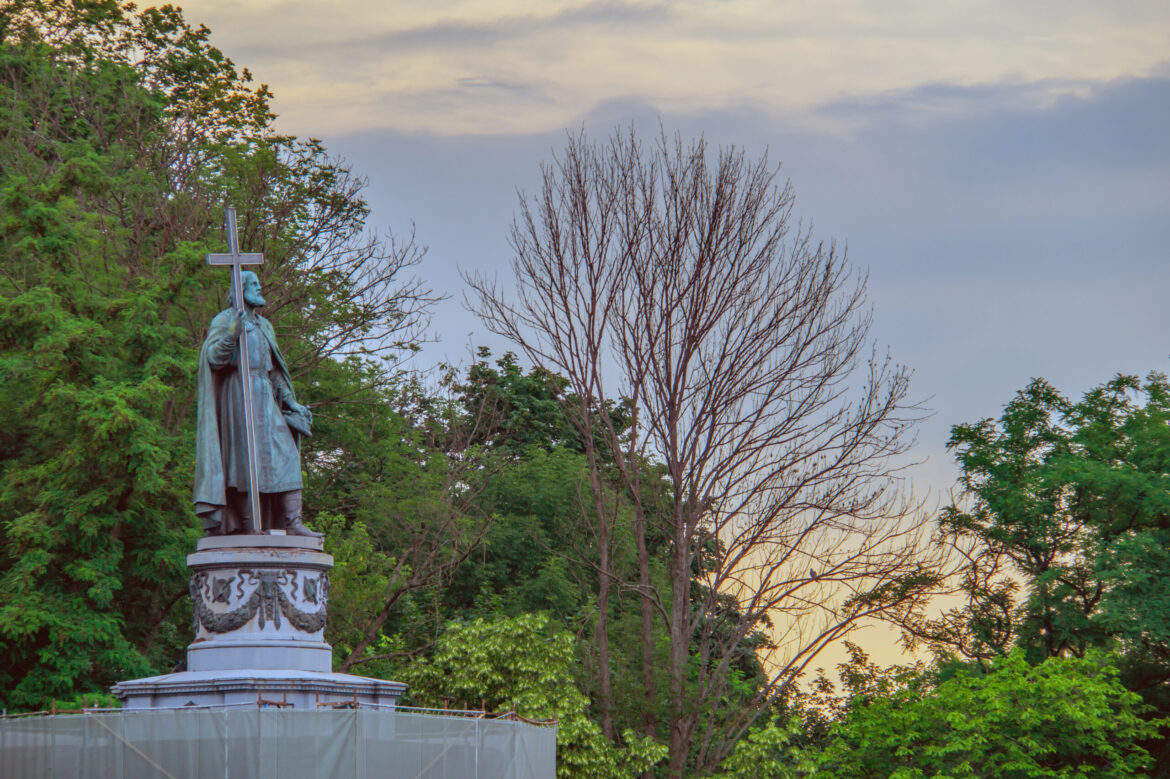
Holy Prince Vladimir, you were like a merchant in search of fine pearls. By sending servants to Constantinople for the Orthodox Faith, you found Christ, the priceless pearl. He appointed you to be another Paul, washing away in baptism your physical and spiritual blindness. We celebrate your memory, asking you to pray for all Orthodox Christians and for us, your spiritual children.

Troparion in Tone 4

In his early life St. Vladimir was a devout pagan. He was a great conqueror who had many wives and erected many pagan statues in the lands that he ruled over. Upon finding out that other faiths existed beyond his own paganism, he decided to send his envoys out into the world to find out what was the true faith on earth.

His envoys met with Muslims, but felt that there was no joy among them, and that their faith was very mechanical. The envoys also met with Jews and Latin Catholics, but were still unimpressed.

Everything changed, however, when the envoys arrived in Constantinople. Upon attending Divine Liturgy in Hagia Sophia, the envoys said, “We no longer knew whether we were in heaven or on earth.”

Taking the word of his envoys, St. Vladimir had himself baptized in Cherson and his nation baptized in the river Dnipro by missionary fathers from Constantinople. Being newly illumined St. Vladimir changed completely after his baptism. His spiritual ascension was marked with a miracle like God’s calling of Saul (Paul) on the road to Damascus – the Prince of Kyiv physically and spiritually recovered his sight: through encouragement by his blessed fiancée, a Byzantine Princess Anna, he regained his physical sight and gained spiritual insight in the baptismal font. Following his baptism he destroyed all the pagan statues that stood in Kyivan Rus’, and replaced them with Churches. He also attempted to live in peace as much as possible with his neighbors and had only one wife.

People called Vladimir “the Beautiful Sun” for his generosity to poor people, for providing clothing and food to cripples and needy persons. He required teaching children the Law of God, built schools and organized orphanages. He departed on July 15th, 1015, and was buried next to his mother Saint Olha’s incorruptible relics. Two of his sons – Boris and Hlib – were later glorified/canonized as Saint Blessed Princes-Martyrs.

“My Lord, my God! I lived without knowing You, but You had mercy on me and enlightened me with Thy Holy Baptism – and I beheld You, God for everybody, Creator of all things animate and inanimate, the Father of our Lord Jesus Christ!”, – these words of Saint Vladimir’s prayer sound as a voice of every Christian soul that went through the crucible of temptations.

35
0 FacebookTwitterPinterestWhatsappTelegramSkypeViberEmail
On 23th June, we welcomed our new priest, the Rev. Philip Gilbert, to our St. Luke UGCC.
Fr. Philip celebrated the Divine Liturgy. After the prayer, all parishioners received the blessing.
Dear Fr. Philip, may our Lord, the Good Shepherd, guide you with His grace and peace. We welcome you with open arms and look forward to your ministry with our parish!
176
0 FacebookTwitterPinterestWhatsappTelegramSkypeViberEmail

Dear Brothers and Sisters in Christ,

I pray you are doing well. Most of you may be aware that I have been assigned to two parishes of our Eparchy in California. I will move at the end of July. Fr. Philip Gilbert, our newly ordained priest, was assigned to St. Luke UGCC.

I’m grateful to God for being with you all this time. Every day has been such a great blessing not only for me but also for my family. Thank you for your Love, Kindness, and Support. With these beautiful gifts of the Holy Spirit, our Mission will flourish and bear the fruit of the Holy Spirit. I will continue to keep all my parishioners, from every parish where I have served, in our daily family prayers.

Please accept Fr. Philip as a gift from God. He has a lot to do in our parish. He needs prayers, support, and encouragement. His beautiful wife is Ukrainian and she will continue to develop the Ukrainian tradition.

Only in unity and with grateful hearts can we develop our congregation.

Now Fr. Philip needs your prayers for safe travels with his wife to Ukraine and for their safe return at the end of August. Also, I ask you to support Fr. Philip through your kind donations, which will be used for his transfer from Kansas.

Here is the link for donation: https://stlukecody.org/donation/ or you can use in our chapel a donation box.

In Christ, Fr. Roman Bobesiuk!

197
0 FacebookTwitterPinterestWhatsappTelegramSkypeViberEmail

“Today a joyous feast has beamed forth to all nations: the most precious memory of the most wise and major Apostles Peter and Paul.”

(Stichera at the Aposticha of the Vespers service of the Feast)

We owe to the Holy Apostles the priceless treasure of the Christian faith. They handed Christ’s teachings down to us. From them, we received the Holy Gospel and the letters of the Apostles. They laid a firm foundation for the Church of Christ.

The servant of God Metropolitan Andrew Sheptytsky speaks beautifully of the significance that the holy Apostles have for us; he says:

“The Apostles in the full sense of the word are our parents in the holy faith. Through their hands, God gave to mankind and to every nation within Christ’s Church all that belongs to the divine apostolic tradition. In our ascetical life and our sermons we must not forget, therefore, that we have received everything from their hands. All that we have, we owe to their apostolic labors and their prayers… St. Paul, the Apostle, claims first place, for in his letters he has given to the Church a rich revelation of God, and a wealth of divine teachings… The Liturgical Year gives the Apostle St. Peter first place, assigning to him two days in the year, namely, January 16th the feast of St. Peter in Chains and June 29.”

(On the Veneration of Saints, 1941)

On the 29th of June our Eastern Church celebrates with great solemnity the feast, which in our liturgical books is called: “The Holy Illustrious and Ever-praised Major Apostles, Peter and Paul.” Both Apostles are distinguished for their character, their zealous apostolic labors and their great cult in holy Church.

The Apostle St. Peter

Jesus Christ, having great plans for St. Peter at the beginning of his calling, changed the name Simon to the symbolic name of Peter-Cephas, which means rock, for he was to be the rock that will form the foundation of his Church. St. Peter was closely associated with Christ during his public life: He witnessed the glory of Christ on Mt. Tabor; in the name of all the Apostles, he professed the divinity of Christ; he was sent with St. John to prepare the Paschal Supper; He witnessed Christ’s agony in the Garden of Olives; the temple tax was paid by Christ for Himself and for Peter.

After the Ascension of Christ, St. Peter became the head of the Apostles and the leader of the first Christian community in Jerusalem. Under his leadership, a new Apostle was elected to take the place of Judas. Peter convoked the first church Council in Jerusalem. St. John Chrysostom calls Peter “the firstborn lamb from the flock of the Good Shepherd.”

The love of Christ was the chief motive of Peter’s apostolic activity, labors and sacrifices. That love finally led him to suffer and die for the sake of his beloved Teacher. A pious tradition relates that he considered himself unworthy to die on the cross as Christ did, and therefore asked to be crucified upside down. This tradition is confirmed by Bishop Eusebius (+340) in his History of the Church and by St. John Chrysostom in a sermon on the Apostles SS. Peter and Paul, in which he says: “Rejoice, Peter, who died on the cross head downward.” St. Peter died in Rome during the reign of Emperor Nero (54-68), between the years 64 and 67 A.D.; St. John Chrysostom following tradition gives June 29 as the day of his death.

St. Paul the Apostle

St. Paul did not belong to the original group of the twelve apostles, but through his apostolic labors, his dedication, his superhuman sacrifices, and his sufferings in the service of Christ, he received the title, along with Peter, of the First Apostle. He is the only one of the Apostles who was highly educated and was by birth a Roman citizen. While Paul was on his way to Damascus, Christ Himself converted him in a miraculous manner and called him to be an Apostle. After his conversion from being a persecutor of Christians, he became, in heart and soul, a zealous and courageous apostle of Christ. “Paul was a wolf,” says St. Chrysostom, “But he became a lamb. He was a thorn, but he became a fruitful vine. From an enemy, he became a friend; from a weed, he became wholesome bread… The blasphemer became a theologian; the persecutor, a herald of good news; the tormentor – a leader; the traitor Apostles) a fellow-champion.” (On the Holy Twelve Apostles)

In his apostolic work, St. Paul distinguished himself as a man of uncompromising character, remarkable strength of will and fervent spirit. For many years, he fearlessly preached the Gospel of Jesus Christ day and night. His unlimited love for Christ knew no obstacles, recognized no difficulties, and placed no limit to sacrifice. His love impelled him to undertake great missionary journeys and to establish new Churches; he was always ready to suffer and die for Christ.

The apostle of the Gentiles was not only an excellent preacher and a good organizer, but also an eminent theologian and writer. From him we have fourteen letters addressed to various Churches or persons in which he clearly expounds the teachings of Christ. St. Paul gave up his life for Christ. According to tradition, he died by the sword in Rome on June 29, 65 or 67 A.D.

The Cult of SS. Peter and Paul

Because of the great significance of these Apostles for holy Church, their cult began from the very moment of their death. Their tombs in Rome were well known and all Christians revered them. St. Jerome (+420) wrote:

“When I was still a young man studying in Rome, I would go with my companions to the tombs of the Apostles and Martyrs.”

In the fourth century, their cult became universal in both the Eastern and the Western Churches. In Constantinople, Constantine the Great (+337) built a magnificent church in honor of the Twelve Apostles; he himself was later buried there.

The oldest church calendars already had the feast of these Apostles. Originally, not all the Churches observed their memory at the same time. The Calendar of Furius Philocalus, from the middle of the fourth century, has the commemoration of Peter and Paul on the 29th of June. The Syriac Calendar of the year 411, on the day of the 28th of December notes: “Peter and Paul, the Major Apostles.” The Georgian Menology also places their feast on the 28th of December. The Calendar of Polemius Silvius (†455), Bishop of the city of Sitten in northern Italy, gives February 22, as the day of the death of Peter and Paul. The Antiochian menology of the fourth century places the feast of St. Peter on June 28 and that of St. Paul on June 29. The Nestorians celebrate the memory of both Apostles on the second Friday after the feast of the Theophany. We learn from a sermon of St. Sophronius of Jerusalem on SS. Peter and Paul that the fourth day after the Nativity of Christ in Jerusalem was dedicated to the two Apostles. Their feast in Rome in the fifth century, according to the testimony of Pope Leo I (+461), even had an eighth day post-feast.

Such distinguished Fathers of the Church as St. John Chrysostom, St. Augustine, St. Ambrose and others left us many beautiful sermons in honor of the holy Apostles Peter and Paul. St. John Chrysostom composed the largest number of sermons given in their honor. It may be appropriate to give a few excerpts here. “Rome has two illustrious eyes,” he says, “they are the bodies of these Apostles (Peter and Paul). The brightness of the sky is due not so much to the sun diffusing its rays, as to these two lights of the city of Rome that illumine the ends of the universe with their radiance.” (Works, Vol. 9, p. 856) “O blessed duo,” he says in another sermon,

“who have faithfully caught souls all over the world! Peter the beginning of the true faith, the greatest highpriest of the Church, the head of Christians, a treasure of heavenly powers, the apostle upon whom Christ Himself bestowed honor. Paul the great Preacher of truth, the glory of the universe, a heavenly man and an earthly angel, splendor of the Church; great eagle that soared to heaven, lyre of the Holy Spirit…Paul and Peter lights of the Church, who daily illumine the faithful; treasuries of the Holy Spirit; enlighteners of the universe; vessels of grace; interpreters of the Holy Trinity; expounders of the divine word… pillars of the Church, great lamps of the universe.”

(Works, Vol. 8, pp. 615-616)

On the feast of SS. Peter and Paul, St. Ambrose taught: “This day, brothers, is well known to us and to the whole world, for today is the commemoration of SS. Peter and Paul. Their feast cannot be confined to one part of the world.” St. Augustine, in one of his sermons in their honor, says: “Although we know from tradition that they did not die at the same time, nevertheless, we honor the memory of both on the same day, since St. Paul died a year later on the same day on which Peter was freed from the bonds of the body and was transferred to the world of the angels.” SS. Andrew of Crete, John Damascene, Cosmas of Maiuma and others composed the service for this feast on the basis of the sermons of St. John Chrysostom. The chief theme of the services for the feast of Peter and Paul consists of their significance for the Church of Christ, their zeal, their dedication, and sacrifice. In the aposticha of Small Vespers we read: “O Peter, foundation of the Apostles, rock of Christian faith, head of the Christians… O Paul, preacher of the gentiles, protector of Christians, lamp of the universe, great voice of Christ, the living God… O Peter, supreme disciple; Paul, the ideal of the Apostles.” The stichera of the Great Vespers service extols them with these praises: “Terrible swords of the spirit, splendid ornaments of Rome, nourishers of the whole universe; spiritual tablets of the New Testament written by God… founders of the Church, true pillars, foundation and trumpets of the divine teachings of Christ, sharer in his sufferings… O Peter, rock and foundation of faith, and Paul, chosen vessel…”

At the sticheras of the Praises in the Matins service, holy Church calls upon all the faithful to glorify the Major Apostles and to take joyful part in their feast: “The solemn feast of the two Apostles has arrived, bringing salvation to all. Therefore, let us spiritually clap our hands and say to them:

“Rejoice, O lights to those who are in darkness, O bright rays of the spiritual Sun. Rejoice, Peter and Paul, immovable foundation of divine teachings, friends of Christ, most precious vessels, come invisibly among us and impart supernatural gifts to those who celebrate your feast.”

On June 30th, the day following the feast of the holy Apostles Peter and Paul, the Eastern Church celebrates the memory of all the Apostles of Christ. In a sermon for this day, St. John Chrysostom praises the holy Apostles in these words: “You are the unshakeable pillars of the true faith, the glory of the Church, the scepters of the kingdom… Here Peter teaches Rome; there, Paul preaches to the world; Andrew in- structs the wise men of Hellas; Simon leads the barbarians to God; Thomas makes the Ethiopians white through baptism; Judea venerates the altar of James; Alexandria falls to the throne of Mark; Luke and Matthew write the Gospels; John, the Revealer of mysteries, in death as in life, has Ephesus under his protection; Bartholomew teaches the Lycaonians moderation. Philip, by a miracle saves Hierapolis. All unceasingly manifest everywhere good things for all. Their very dust, even in their graves, is immortal. Now they are servants, but later they shall sit as judges of the world.” (Work, Vol. 8, p. 619)

22
0 FacebookTwitterPinterestWhatsappTelegramSkypeViberEmail
As we expect the visitation of Bishop Benedict, here are some information about HIERARCHICAL PRIESTHOOD and our Bishop Benedict.
ABOUT HIERARCHICAL PRIESTHOOD
According to Canon Law
CAN. 177 §1. An eparchy is a portion of the people of God that is entrusted to a bishop to shepherd, with the cooperation of the presbyters, in such a way that, adhering to its pastor and gathered by him through the Gospel and the Eucharist in the Holy Spirit, it constitutes a particular Church in which the one, holy, catholic and apostolic Church of Christ truly exists and is operative.
CAN. 178 The eparchial bishop, to whom the eparchy has been entrusted to shepherd in his own name, governs it as the vicar and legate of Christ; the power which he exercises personally in the name of Christ, is proper, ordinary, and immediate, although by the supreme authority of the Church its exercise is ultimately regulated and can be circumscribed within certain limits in view of the benefit of the Church or of the Christian faithful.
According to Catechism
The fullness of pastoral ministry is given to the bishops. They are heirs to the fullness of the apostolic ministry, that is, to the fullness of the grace of the priesthood. In his eparchy, the bishop is the one who has primary responsibility for teaching the Word of God, leading the people of God, and sanctifying them. The sanctifying ministry particular to a bishop is the ordination of bishops, presbyters, and deacons, the consecration of Holy Chrism, and the consecration of antimensia.
The Rites of Ordination of Bishop
At the ordination of a bishop, which requires no less than three other bishops, the candidate declares a profession of faith in which he expounds in detail the Church’s doctrine about the Most Holy Trinity, the Incarnation, and the Holy Mysteries. This is because the bishop is the teacher and the one who proclaims the Gospel to his flock. Through the ordaining bishop, the Church asks Christ that the one receiving the grace of the high-priesthood may become “an imitator of the true Shepherd, who laid down his life for his sheep; a guide to the blind; a light to those in darkness; discipline for the unwise and a teacher to children; a beacon in the world; that he may lead to perfection the souls entrusted to him. “370 Symeon of Thessalonica explains that through ordination, the bishop, as the head of the local Church entrusted to him, “accepts as a bride the one who is the bride of Christ,” that is, the Church. “This is because [Christ] taught us that pastoral care and concern for her is evidence of love for him.”371 The close bond established between the newly ordained shepherd and his flock is expressed several times during his ordination by the explicit naming of the local Church (eparchy) to which he is ordained. The presence of no less than three ordaining bishops, that is, bishops of other eparchies, bears witness to the bond that exists between local Churches. The Church’s unity is thus manifested.
About Most Rev. Benedict (Aleksiychuk)
Most Reverend Bishop Venedykt (Aleksiychuk), bishop of Ukrainian Catholic Eparchy of Chicago(born January 16, 1968 in Borshchivka, Kostopil Raion, Rivne Oblast, Ukrainian SSR). Became Auxiliarybishop of Lviv on September 5, 2010; became bishop of Ukrainian Catholic Eparchy of Chicago on April 20, 2017.Most Reverend Bishop Venedykt (Aleksiychuk), bishop of Ukrainian Catholic Eparchy of Chicago(born January 16, 1968 in Borshchivka, Kostopil Raion, Rivne Oblast, Ukrainian SSR). Became Auxiliarybishop of Lviv on September 5, 2010; became bishop of Ukrainian Catholic Eparchy of Chicago on April 20, 2017.
Biography
Was born on January 16, 1968 in Borshchivka village, Kostopil district, Rivne region.
From 1975 till 1983 he studied at the Borshchivka grade school (eight-grade school).
In 1983 he began his studies at Rivne medical college, completing his degree in 1987 as a Physician’s Assistant. After graduation, he worked as an Emergency Medical Technician at the Ambulance Station in Kostopil.
From 1987 to 1989 he served in the military. Afterwards, from 1989 to 1990 he worked as a Physician’s Assistant, initially at a city clinic, and later at the sanatorium “Karpaty” in the city of Truskavets.
From 1990 to 1993 he studied at the Drohobych Spiritual Seminary. On October 9, 1991, he was ordained a deacon by Bishop Phylymon (Kurchaba). On March 29, 1992 he received his priestly ordination from His Beatitude Myroslav-Ivan (Lyubachivskyi).
In April 1992 he was appointed administrator at a parish in Bystrytsia village, Drohobych deanery. Simultaneously he served as Assistant Priest at Holy Trinity Church in Drohobych and was responsible children’s ministry within the deanery. From 1992 to 1994 he also worked for the Patriarchal Catechetical Commission where he was responsible for the organization of mission work in Eastern Ukraine.
On May 13, 1993, he joined the Univ Holy Dormition Lavra of the Studite Order. He accepted Tonsure on October 13, 1993, and received the Little Schema on December 31, 1995.
Beginning in July 1994 he worked on the renewal of monastic life and the restoration of the Monastery of Borys and Hlib in Polotsk (Belarus), while simultaneously serving at the parishes in Polotsk, Vitebsk, Gomel, Mogilev, Brest (Belarus Greek Catholic Church). He was the spiritual father of Christian Youth Community in Minsk.
In 1996 he completed a Masters of Theology Degree at Lublin Catholic University. The topic of his master’s thesis was “Christian spirituality according to St. John of Kronstadt”.
On December 3, 1996 he was transferred to St. Catharines, Canada with the aim to found a monastery there. At the time, he also served at the parishes of Grimsby and Beamsville (Toronto Eparchy of the UGCC). He returned to Ukraine in April 1999, after being elected hegumen of the Holy Dormition Univ Lavra. In May 2000 he was re-elected hegumen and in May 2005 elected for a third term.
In October 2004 he continued his theological studies at Lublin Catholic University, completing his Licentiate Degree in 2006. At the same University, on April 18, 2008 he defended his PhD thesis on the topic “The Superior as a Spiritual Father. Investigation in the light of the works of Saint Theodore the Studite.”
2004-’10 – Served as a member of the Patriarchal Commission of Monasticism.
2006 – Served as administrator of St. Nicholas parish in Peremyshlyany.
2006-’08 – Served as the Head of the Secretariat of UGCC Council of Monasticism.
2007-’09 – Headed the UGCC Liturgical Council on preparing texts of divine services.
2007-’10 – Served as the Head of the Council of Higher Superiors of Monasteries of the UGCC.
2009 – Appointed a member of the Secretariat of the Patriarchal Sobor, which was held in Brazil in 2011.
2008-’10 – He completed a course of Practical Psychology at the European School of Correspondential Education (Kharkiv).
2009-’10 – Studied “Propaedeutics of mental disorders” at the Ukrainian Community of Psychiatrists.
2009-’12 – Studied pedagogy and psychology at the Ignatianum Academy in Krakow (Poland).
On August 3, 2010 His Beatitude Lyubomyr Husar, Major Archbishop of Kyiv-Galicia, by general consent of the Synod of Bishops of the UGCC, appointed hieromonk Venedykt Aleksiychuk bishop-auxiliary of Lviv Archeparchy.[1] His Episcopal Chirotonia (Ordination) was held on September 5, 2010 at St. George’s Cathedral in Lviv (the main consecrator – Archbishop Ihor Voznyak, Metropolitan of Lviv, co-consecrators: Bishop of Sambir-Drohobych Yulian Voronovskyi and Bishop of Stamford Pavlo Chomytskyi).
On September 8, 2010 he was appointed the Head of Staff of the Lviv Archeparchy Curia.
On September 26, 2011 he was appointed the Head of the Patriarchal Liturgical Commission of the UGCC. He also currently serves as the Chair of the Synodal Committee on Liturgical Issues.
Since 2014 he has been a member of the charitable religious community “Saint Sophia” in Rome.
In 2014 to 2016 he studied in the Key Executive MBA Program at the Ukrainian Catholic University in Lviv and obtained a Masters Degree in Business Administration in June 2016.
On July 13, 2015 His Beatitude Sviatoslav named him a Senator of the Ukrainian Catholic University.
On December 14, 2015 he was awarded with the Cross of Military Chaplain.
On April 20, 2017, Pope Francis appointed him Bishop of the Eparchy of Saint Nicholas of Chicago of the Ukrainians, United States of America.
https://en.wikipedia.org/wiki/Venedykt_Aleksiychuk
It is with great joy that we invite all our Parishioners to the upcoming visit of Bishop Benedict Aleksiychuk to Cody, and the regional area.
We are so blessed to have His presence on June 2nd; this is very apropos, as we will have the First Confession and Solemn Communion of our children and induction of our Altar Servers.
Join us for Liturgy and fellowship on Sunday, June 2nd at 9:45 am in St. Luke’s Chapel (1922 Big Horn Ave, Cody)
Please feel free to stop and visit with His Grace after Divine Liturgy.
We will have a potluck. Please bring your favorite meal to be shared.
We are waiting for you!
69
0 FacebookTwitterPinterestWhatsappTelegramSkypeViberEmail

© 2024-2025 – All Right Reserved. St Luke Ukrainian Greek Catholic Church