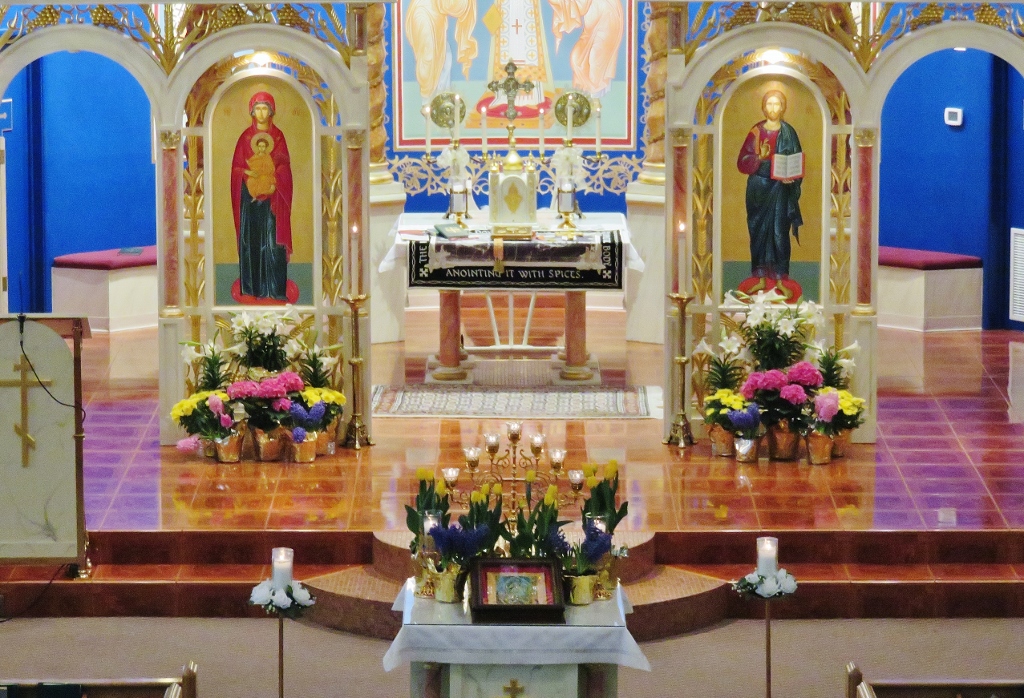
Sunday, June 28, 2026
St Luke Ukrainian Greek Catholic Church

Cody

“We have seen the true light, we have received the Heavenly Spirit, we have found the true faith, we worship the undivided Trinity, for It has saved us.”

(Stichera of Solemn Vespers of the Feast of the Pentecost)

The glorious feast of the Resurrection concludes with a feast also most glorious and great and that is, the feast of the Pentecost. After the Nativity and Resurrection of our Lord this feast belongs to the greatest feasts in the Ecclesiastical Year. The Descent of the Holy Spirit is, as it were, the seal on the work of the salvation of the human race accomplished by the Son of God. On the day of Pentecost the Holy Spirit himself anoints the Apostles as preachers of the Good News of Christ. On this day the Church was born and began to function. The Holy Spirit ever guides, enlightens, sanctifies and preserves her on the path of truth.
“When the work the Father gave to the Son to do on earth was accomplished,” says The Vatican Council,

“the Holy Spirit was sent on the day of the Pentecost in order that He might continually sanctify the Church, and thus all those who believe would have access through Christ in one Spirit to the Father… The Spirit dwells in the Church and in the hearts of the faithful, as in a temple. In them, He prays on their behalf and bears witness to the fact that they are adopted sons… By the power of the Gospel He makes the Church keep the freshness of youth. Uninterruptedly, He renews it and leads it to perfect union with its Spouse.”

(Constitution on the Church, §4)

The holy feast of Pentecost deserves our special attention because of its history, liturgy, and significance. The Old Testament Pentecost
The Jewish people in ancient times celebrated three great feasts annually: the feast of the Passover, the feast of the Pentecost and the feast of Tabernacles. In the Book of Exodus we read:

“Three times every year you shall celebrate feasts to me. You shall keep the feast of the unleavened bread. You shall keep the feast of the harvest of the first-fruits of your work, whatsoever you have sown in the field, and the feast also in the end of the year, when you have gathered in all your crops out of the field.”

(Exodus 23,14-16)

The feast takes its name from the fiftieth day after the feast of the Passover, and also from the fiftieth day from the beginning of the harvest. Pentecost is a Greek word which means “the fiftieth day”. Originally, Pentecost was a feast of harvest and thanksgiving. On that day, according to the prescription of the law, great crowds of Jews would flock to Jerusalem even from distant lands, to render thanks to the Lord for the fruits of the earth and to make an offering of these fruits in the temple. Later, the Jews connected the feast of Pentecost as a feast of the harvest with an event in the history of Israel, in this case, with the anniversary of the giving of the Law to Moses on Mount Sinai on the fiftieth day after their departure from Egypt.

The Christian Pentecost
The Apostles and first Christians retained from the Old Testament the feast of the Passover as well as the feast of the Pentecost. They also preserved the name, Pentecost, because, for them, it was also the fiftieth day after the Pasch (Resurrection); however, they attached to it an altogether different significance.
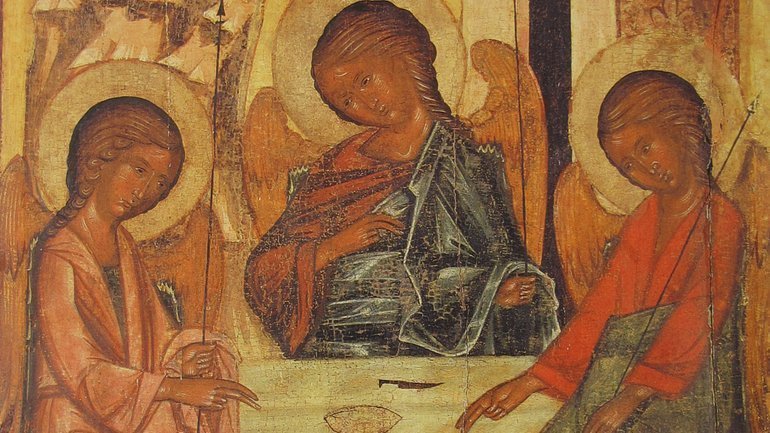
The principal motive for celebrating Pentecost in the Church of the New Testament was the event of the Descent of the Holy Spirit upon the Apostles. Thus, this feast is also called the day of the Descent of the Holy Spirit or the day of the Holy Trinity.
The Descent of the Holy Spirit was, for the primitive Christian Church, such a joyous, solemn and significant occasion, that they placed this feast on the same level with the feasts of the Resurrection and the Nativity of Christ. The celebration of this feast, like the feast of the Resurrection, in time, was extended to an entire week, during which the faithful also enjoyed the privilege of Free Days. In the third century, this feast became universally known. The service, honoring this feast, was composed in the eighth century by St. John Damascene and St. Cosmas of Maiuma.
The liturgy of this day is full of joy and praise of the Holy Spirit and the Holy Trinity. “Come all you nations,” we sing in the stichera from the Vespers service of this feast, “let us worship the Divinity in Three Persons, the Son in the Father with the Holy Spirit. The Father from eternity had begotten the Son, co-eternal and co-reigning with him; and the Holy spirit was in the Father, glorified with the Son one Power, one Being, one Substance, one Godhead, which we all worship, saying: ‘Holy God – who created everything through the Son with help of the Holy Spirit; Holy Mighty One – through whom we knew the Father, and through whom the Holy Spirit came to the world; Holy Immortal One Spirit, Comforter, who proceeds from the Father and rests in the Son, O Holy Trinity, glory be to you”. In the Matins service, at the Sticheras of Praises, we praise the Holy Spirit: “The Holy Spirit was, is and always will be. He is without beginning and without end, equal in essence with the Father and with the Son. He is life and the giver of life; he is light and the giver of light, he is all good and the fountain of all goodness…”
The following well-known prayer to the Holy Spirit from the service of the Pentecost found its way into our daily prayers: “Heavenly King, Comforter, Spirit of truth, everywhere present and filling all things, Treasury of good things and Giver of life, come and dwell in us and cleanse us of all stain and save our souls, O Good One.” All our church services begin with this prayer.
The Church of the Old Testament had a custom on the feast of Pentecost of covering the floor of their homes and synagogues with fresh grass and adorning their homes and synagogues with the branches of trees and with flowers as a sign that, when the Law of God was given at Mount Sinai, all nature was in bloom. Presumably, the Apostles also observed this custom and decorated the upper room with greenery and flowers. This custom was also taken over by the Church of the New Testament. From this custom, Pentecost received another name namely, “Green Sunday”, Flowers and greens are a sign of life and therefore became a symbol of the life-giving Spirit. Just as nature in springtime is renewed with greens and flowers, so too, holy Church and her faithful are renewed by the power of the Holy Spirit.
On the Monday following the feast of the Pentecost, our Church celebrates the feast of the Holy Spirit. The feast of Pentecost commemorates the event itself of the descent of the Holy Spirit upon the Apostles, while Monday is dedicated to paying special worship to the Holy Spirit as the Third Person of the Trinity. In regard to this special worship, the Monday Synaxary says: “On this day, i.e., the Monday of Pentecost, we honor that all-holy and life-giving and all-powerful Spirit, one God in the Holy Trinity, one in dignity, one in nature, and one in glory with the Father and with the Son… Out of deep onference for the all-holy Spirit the Holy Fathers decreed that neseparate feast be celebrated also during the Pentecost, in honor of Him who is the author of all that is good.”
The Synods of Zamost and Lviv, when listing all the feasts, call this day the feast of the Holy Trinity. The Typicon of Father I. Dolnytsky calls this day simply the Monday of the Pentecost, and says that, on this day, the entire service of the feast of the Descent of the Holy Spirit is used and “in the Divine Liturgy the service of the feast of the Holy Trinity may also be used, if one desires.” He noted that neither the Greek nor the Slavonic typicons, except for our Sluzhebnyks (Liturgikons-Missals), have this service, which must be celebrated only in churches dedicated to the Holy Trinity. Since the Middle Ages the Latin Church keeps the feast of the Holy Trinity on the eighth day after the Pentecost, that is, on our Sunday of All Saints. Prince Maximilian, a Roman Catholic priest, in his “Lectures on the Eastern Liturgies”, says that “Ukrainian Catholics, imitating the Latin Church, celebrate the feast of the Holy Trinity on the Monday after the Pentecost (p. 99). Actually, the feast of the Pentecost, properly speaking, is the feast of the Holy Trinity, as is evident from the name and the content of the service of that day.
The Vespers service of Monday merits special attention. Ordinarily it is not performed on Sunday evening, but immediately after the Divine Liturgy around noontime on the very day of the Pentecost. The linking of the Vespers service with the Divine Liturgy is explained by Father I. Dolnytsky as an opportunity for the faithful who are present at the Divine Liturgy to take part in the prayers which are read while kneel- ing. This Vespers service, characterized by three special prayers of a penitential nature, were allegedly composed by St. Basil the Great (†379). The Byzantine Canonist Matthew Blastares (14th c.) testifies in his Nomocanon that St. Basil the Great also directed that these prayers be said while kneeling, as a sign of great respect for the Holy Spirit.

The Significance of the Feast of the Descent of the Holy Spirit
The event of the descent of the Holy Spirit was most fruitful in its effects and had great significance for the Apostles and the first Christians; it has this same significance for the whole Church everywhere and always. St. John Chrysostom in his homily on the feast of the Pentecost says:

“The all gracious God today bestowed upon us gifts, too great to be adequately expressed in words. Therefore, let us all rejoice together, and while rejoicing, let us praise our God… For I ask, what was given to us for our salvation that was not given to us by the Holy Spirit? He freed us from slavery, adopted and called us to the freedom of the children of God. From this fountain (i.e. the Holy Spirit) flow prophecies, the grace of healing, and all the other gifts and fruits with which the Church is wont to adorn herself.”

In the sticheras of the Great Vespers service of Pentecost we read:

“The Holy Spirit is the giver of all gifts. He pours forth prophecies, perfects the priesthood, teaches wisdom to the illiterate, and transforms fishermen into theologians; he brings together into one community the entire Church of God. O Comforter, one with the Father in nature and co-reigning with Him, glory to you.”

“Through the Holy Spirit,” says St. Basil the Great, “our return to paradise is achieved, we are elevated to the heavenly kingdom, and become once more the children of God. Through Him we are able to call God, Father; we are able to become partakers of the grace of Jesus Christ, to be called children of light, and to share in everlasting glory…” (On the Holy Spirit, ch. 15)
The Holy Spirit bestowed upon the Apostles the gift of tongues, the gift of understanding the Scriptures, and the gift of fortitude in preaching and professing the holy faith. “On the day of Pentecost,” says the Second Vatican Council,

“the Holy Spirit came down upon the disciples to remain with them forever. The Church was publicly displayed to the multitude, the Gospel began to spread among the nations by means of preaching, and there was presaged that union of all peoples in the catholicity of the faith by means of the Church of the New Covenant, a Church which speaks all tongues, understands and accepts all tongues in her love…”

(On Mission Activity of the Church, р. 4)
The gifts of the Holy Spirit are truly numerous and great. St. Paul speaks of them in his letter to the Galatians: “But the fruit of the Spirit is: charity, joy, peace, patience, kindness and goodness, faith, modesty, continency.” (Gal. 5,22-23) The Holy Spirit has also descended upon us with his gifts in the Sacrament of Confirmation and he has anointed us as soldiers of Christ and made our bodies His temples. St. Paul reminds us of this great truth, admonishes and exhorts us to live accordingly:

“Do you not know that your members are the temple of the Holy Spirit, who is in you, whom you have from God, and that you are not your own? For you have been bought at a great price. Glorify God and bear Him in your body.” (I Cor. 6,19-20)
18
0 FacebookTwitterPinterestWhatsappTelegramSkypeViberEmail

On the fortieth day after His glorious resurrection Jesus Christ ascended into heaven, and on the fiftieth day sent down the Holy Spirit upon the Apostles. For this reason, the fifty day period extending from Easter to the feast of the Descent of the Holy Spirit (Pentecost) is called the season of Pentecost. The feast of Pentecost or the Descent of the Holy Spirit bears the same name.
Great feasts are usually celebrated for several days after the feast itself. This continuation of the celebration is called the post-feast. The feast of the Pasch, the most prominent and solemn of all the feasts, has the longest post-festive period; it lasts until the feast of the Ascension of our Lord. During this period the services begin and end with the hymn of the Resurrection: “Christ is risen from the dead…” The Sundays of the Pentecost season are named according to the Gospel event of the day. The Gospel events and the services of those Sundays have for their purpose the glorification of the risen Christ and the strengthening of our faith in his divinity. During the period of Pentecost we celebrate three feasts that deserve our special attention: 1) the Sunday of Thomas, 2) the Mid-feast i.e., the “Middle Wednesday” or Mid-Pentecost (in Ukrainian “perepolovynennya” or “Half-Way” that is, the half-way mark or midway of the Pentecostal season or Mid-Pentecost) and 3) the Ascension of our Lord.

Thomas Sunday
The Sunday following Easter Sunday also has the following names:
The Sunday of St. Thomas from the Gospel event in which St. Thomas meets the risen Christ.
The Sunday of the Anti-pasch Anti-pasch is a Greek word signifying “in place of, instead of the Pasch”, for, to the Christians, this Sunday was, so to speak, a repetition of the feast of the Resurrection (Easter). In the Diary of a Pilgrimage written by Silvia of Acquitaine (4c) we read that on the eighth day after the Resurrection of Christ there were special celebrations in Jerusalem and that, on this day, the Gospel relating to the conversion of St. Thomas was read.
The New Sunday or The Sunday of Renewal or Renovation for it was on the first Sunday after the Resurrection that the celebration of the Pasch was, as it were, renewed. On this day Christ, himself, by appearing to His Apostles, renewed the joy of the Resurrection. “On this day,” says the Synaxary of Thomas Sunday, “the first Sunday after the Resurrection, we celebrate the renewal of Christ’s resurrection and the touching of His wounds by St. Thomas.”
White Sunday or Sunday “in white” – In ancient times the neophytes or the newly baptized, having received the Sacrament of Baptism on Great Saturday, wore a white garment throughout the entire Bright Week, and on the Sunday of St. Thomas they put aside this garment during a special ceremony. To this day the Western Church calls this Sunday “Sunday in White” or White Sunday.
The Leading Sunday or the First Sunday after Easter (the Pasch) Some authors derive this name from the fact that this Sunday is the leading Sunday, i.e., the first Sunday that continues the feast of the Pasch. Among our people there existed an old custom, on the Sunday of St. Thomas, of commemorating the dead with a special memorial repast and pray- ing for their souls at the cemetery.
The celebration of the eighth day after the Pasch as the conclusion of Bright Week, from earliest times, had been regarded as a separate feast. The theme of the services of this feast and of the week that follows is the Gospel event describing the apparition of Christ on the eighth day after His Resurrection and the moving scene of St. Thomas’ conversion and profession of faith. Regarding the significance of this feast, St. Gregory the Theologian (+389), in a homily on the Sunday of St. Thomas said: “The old law, which was established for a good purpose, honors the day of renewal, or rather, should we say, that with the day of renewal it honors new blessings. For, was not the first day of the resurrection, which occurred after the holy and glorious night, also a day of renewal? Why, then, do we give this name to today’s feast? That day (i.e. of the Resurrection) was a day of salvation, while this day is the commemoration of salvation. By its very nature, that day separates the burial and the resurrection, while this day is a day of an altogether new birth… Today we celebrate a genuine renewal, going from death to life. Therefore, cast off the old man and renew yourselves and live in newness of life.”
Our Church celebrates the memory of St. Thomas the Apostle on the 6th of October, whereas the Latin Church celebrates it on the 21st of December. About the apostolic work of St. Thomas, in a homily delivered on Thomas Sunday, St. John Chrysostom eulogizes St. Thomas thus: “Of all the other Apostles he was, at one time, the weakest in faith but, with God’s grace, he became more courageous and more untir- ing than the rest. He traversed almost the whole known world, preaching the word of God fearlessly to nations that were fierce, savage and bloodthirsty.” St. Thomas is believed to have died a martyr’s death for the Christian faith in India.

The Mid-Pentecost
On Wednesday after the Sunday of the Paralytic, which falls exactly in the middle of the Pentecost season, that period between Easter (the Resurrection) and the feast of the Pentecost or Descent of the Holy Spirit, the Eastern Church celebrates the feast of Mid-Pentecost which may mean “Half Way” because it is the half-way mark between the feast of Easter and the feast of the Pentecost, or “Middle Wednesday” since it falls on the Wednesday in the middle of the Pentecostal season. In Church Slavonic this Wednesday or feast is called “Prepolovynennya”; in English “Half Way” (midway) (or Mid-Pentecost). The Synaxary of that day explains the reason for the institution of this feast: “On the Wednesday of the Paralytic we celebrate the feast of Mid- Pentecost for the sake of honoring the two great feastdays Easter and the Pentecost. The feast of Mid-Pentecost unites and joins these two feasts.” The feast of Mid-Pentecost has an eight day post-feast which lasts to the Wednesday after the Sunday of the Samaritan Woman.
The reason for this feast is based on the Gospel of St. John in which it is written: “When, however, the feast (i.e., the feast of Tabernacles) was already half over, Jesus went up in- to the temple and began to teach.” (John 7,14) There he spoke of his divine mission and of miraculous water: “My teaching is not my own, but his who sent me… If anyone thirst, let him come to me and drink. Whoever believes in me, as Scripture says, ‘from within him there shall flow rivers of living waters. He said this, however, of the Spirit whom they, who believed in him, were to receive.” (John 7,16; 37-39)
This feast was already observed at the time of St. John Chrysostom (+407). The liturgy or service for the feast of Mid-Pentecost was composed by Anatolius, Patriarch of Constan- tinople (+458), St. Andrew of Crete, (+740), St. John Damascene (1749) and St. Theophane the Confessor (1817).
The feast of the Mid-Pentecost aims to strengthen our faith in the risen Christ, to inspire us to observe the commandments of God and to predispose us for the feast of the Ascension of our Lord and the Descent of the Holy Spirit. In the Matins service of that day at the Sticheras of Praises we sing: “Brethren, having been enlightened by the resurrection of the Saviour Jesus Christ, and having reached the halfway mark of the feast of the Lord, let us sincerely observe the commandments of God, so that we may become worthy to celebrate the Ascension and receive the coming of the Holy Spirit.”

The Ascension of Our Lord
The feast of the Lord’s Ascension always falls on a Thurs- day, on the fortieth day after Christ’s resurrection. This is one of the principal feastdays of our Lord and therefore, has a post-feast of nine days. It celebrates the memory of Christ’s Ascension into heaven and underscores its significance for Christ and for us. St. John Chrysostom, in his homily on the Ascension says: “Today the human race is completely reconciled with God. The ancient battle and enmity have disappeared. We, who were unworthy to live even on earth – are now lifted up to heaven. Today we become heirs to the kingdom of heaven, we, who do not even deserve earth, we ascend to heaven and inherit the throne of the King and Lord. Human nature, against which the cherubim guarded paradise, is now raised up above all the cherubim.” Sources of the first three centuries do not speak of this
feast. Not even the writer Origen (+251) mentions it, although he lists the Christian feasts in the eighth book of his work
“Against Celsus”. Liturgical experts are of the opinion that in the first three centuries the celebration of this feast was combined with that of the feast of the Descent of the Holy Spirit (Pentecost). Silvia Egeria does not call this feast the “Ascension”, but only “the fortieth day after the resurrection of Christ.”
In the fourth century the feast of the Lord’s Ascension became a universal feast, celebrated everywhere. The Historian Socrates (†c.440) calls it a “general feast”. (History of the Church, 7,26)
The feast of the Ascension was highly extolled in the sermons of St. John Chrysostom, St. Gregory of Nyssa, St. Epiphany of Cyprus, Leo the Great and others. In the fourth century, Queen Helena erected a church at the place of Christ’s Ascension in honor of this feast.
The spirit of the services of this feast, as a whole, is uplifting and joyful. The Church rejoices at the glory of Christ (God and Man), who is now seated at the right hand of the Father. He ascended into heaven, in order to send us the Comforter the Holy Spirit and to “prepare a place for us,” (John 14,2) as he promised.
“The Lord ascended into heaven,” we sing in the first stichera of the Great Vespers service of the feast of the Ascension, “in order to send the Comforter to the world. Therefore, heaven prepared a throne for him and the clouds assisted him in his ascent. The angels wonder as they see a man more exalted than they. The Father receives into his bosom him, who is eternally with him. The Holy Spirit commands all his angels:
Lift up your gates’ lintels, O princes; all you nations clap ” your hands; for Christ has ascended whither He was before.”

11
0 FacebookTwitterPinterestWhatsappTelegramSkypeViberEmail

Most Reverend Archbishops and Bishops,

Very Reverend and Reverend Fathers,

Venerable Brothers and Sisters in Monastic and Religious Life,

Dearly Beloved Laity in Christ of the Ukrainian Greek-Catholic Church

O my Saviour, living and unconsumed sacrifice!

As God, you offered yourself willingly to the Father,

And you raised with you the forefather of all, Adam,

Having risen from the tomb.

Ode 6, Paschal Canon

Christ is Risen! 

Beloved in Christ!

As we celebrate Christ’s Pascha again amid the horrors of a full-scale war, now in its third year, we enter ever deeper into the great mystery of sacrifice offered by the Lord Jesus for our salvation. The Son of God, becoming man, gives back to the Father that which is the most precious—his life! The essence of Pascha’s power, the only thing capable of overcoming violence, abuse, and death, is revealed to us in the voluntary self-sacrifice of Christ. This is beautifully stated in the anaphora of the Divine Liturgy of St. Basil the Great: “And when He had descended through the Cross into Hades, so that He might fill all things with Himself, He loosed the pangs of death, and rose on the third day, and paved the way for all flesh by the resurrection from the dead, for it was not possible for the Prince of life to be mastered by corruption.”

O my Saviour, living and unconsumed sacrifice!

Today, our hearts are filled with the joy of the resurrection of Christ, who emerges in radiance from the grave. The empty tomb reveals to us the fullness of life in the Lord to which we are called in the joy of God’s children. This joy is given to all who see in the wood of the cross the door to renewed life in the resurrection. Because Christ, being the living God, out of great love for us, chose to voluntarily accept suffering, crucifixion, and death, in order to resurrect fallen human nature with himself, and to give us eternal life in his resurrection. By uniting with Christ crucified on the cross, we receive the fruit of his sacrifice in the resurrection from the dead.

In proclaiming this Paschal Mystery, the Church today also directs us to our forefather Adam, whom Christ, in his resurrection, frees from the shackles of hell, and reveals to us the truth—that for humankind life after death really exists! In the person of Adam all humanity is depicted—past, present, and future. The risen Christ is the one who gives meaning to the fullness of human history, which leads from sin and the fall, slavery and bondage, to repentance, conversion, liberation, and salvation. In celebrating Christ’s Pascha, today we reach beyond the limits of our time and space, and enter into the eternity of God. In the Risen Christ, we can boldly say: “Behold, now is a favourable time, behold, now is the day of salvation” (2 Cor. 6:2).

As God, you offered yourself willingly to the Father!

The resurrection of the Son of God demonstrates that his voluntary self-sacrifice is not the end but a new beginning of life for each of us. Christ’s voluntary death on the cross is terrible, real, but life-giving, because it is a “living and unconsumed sacrifice.” Indeed, we are not called to death and nothingness but to life and joy in God. Whoever sacrifices oneself not for the purpose of fulfilling one’s own ambitions, personal goals, or human intentions but gives oneself voluntarily to the Father—is already risen! In this is found the essence of every true sacrifice—to give the Creator one’s everything, that is, to return to God that which is God’s because we are the creation of his hands! That is the meaning of human life itself: we received it as a gift from God and we are called to return it to him alone! By sacrificing ourselves to the Father, we complete ourselves fully in God’s eternal love. By giving ourselves we do not lose anything, but on the contrary, we rise together with Christ! That is why we often repeat in our liturgical services: “let us commend ourselves, and one another, and our whole life to Christ our God.” In the Risen Christ, the value and purpose of every human self-sacrifice is revealed.

Today, Ukraine is a victim-sacrifice of russia’s criminal war against our people. We often ask ourselves: is our fight really worth such a high price? Over these past years for what do we sacrifice that which for us is the most precious: our sons and daughters, brothers and sisters, fathers and mothers; our cities and villages, our land and everything we possess? For what purpose do we live and die today? In response to this cry of anguish and tears of Ukraine, today the Risen Saviour comes forth from the empty tomb as a “living and unconsumed Sacrifice.” It is He, the Victor, who speaks to us today in the voice of fallen heroes: “We fell so that you may live! We sacrificed our lives as an offering to God and to you! In our sacrifice the Lord’s Pascha is proclaimed!” Our victory over the enemy is as certain and inevitable as the day that always follows the night, as the dawn of that morning when Christ was risen, changing the weeping and tears of the myrrh-bearers into the peace and joy of every person who today proclaims to the whole universe: “Christ is risen from the dead, trampling down death by death, and to those in the tombs giving life!”

You raised with you the forefather of all, Adam, having risen from the tomb!

In his resurrection, Christ destroyed death and fear before those who carry it. The Apostle to the Nations states that it was through the fear of death that the devil held the human race in his slavery: “Since therefore the children share in flesh and blood, he himself likewise partook of the same things, that through death he might destroy the one who has the power of death, that is, the devil, and deliver all those who through fear of death were subject to lifelong slavery” (Heb. 2:14-15). The Lord destroyed this fear once and for all, destroyed the power of the devil, the bearer of death, and that is why we call out to him today: My Saviour!

Today Ukrainians sense that in the third full-scale year of a ten-year war, which, in fact, has been going on for centuries, the time has come to destroy once and for all, in Europe and the world, the realm of deathly fear, carried by the insatiable Russian slavemaster and colonizer, to destroy the rule of those who for centuries kept in this slavery to fear our people and other enslaved nations. Today in Ukraine, the one who rains death onto the field of life is losing power. The power of Christ’s Pascha put an end to the power of the devil, the author of slavery, insolence, falsehood, and violence. Indeed, in Christ we voluntarily give ourselves to the Father as a living and life-giving sacrifice. Today in the Paschal Victory the pascha of Ukraine is fulfilled. Today, Christ rises in our struggle against evil, in our efforts, in the flesh and blood of our people, in order to raise up humanity of the third millennium and give hope to the world – for in Ukraine, Christ is Risen!

Dear Brothers and Sisters in Christ! On this radiant day, one of victory of life over death, good over evil, truth over falsehood, I urge you to abide in the faith, hope, and love that the Risen Lord brings us. In the joy of the Resurrection, I greet our military heroes, sons and daughters of Ukraine, who defend us at the frontlines, are ready to sacrifice everything out of love for their land and their people. We believe in your God-given strength, we revere your resistance to evil, over which we shall inevitably prevail.

I greet all those who have suffered from the war—physically, materially, morally. Let today’s feast above all feasts, and festival of festivals, be for you a balm in your suffering. In a special way, I embrace with my paternal love the families of the fallen, expressing my personal gratitude and the gratitude of all God’s people to you, as you bear in the depths of your heart the indescribable pain of losing your son or daughter, brother or sister, husband or wife, father or mother. I embrace the wounded. You carry the seeds of resurrection together with Christ, for He too carried the wounds of the crucifixion on His hands and feet. May the joy of Pascha pave the way to your physical and moral healing. Тo the families of our prisoners and those missing in action, who are celebrating Easter today in tears, I express my compassion, support and prayerful closeness. To all those who have been deprived of their homes by the war and expelled from their hometowns or villages, to all internally displaced persons, and to all those who found temporary sanctuary outside their homeland, I wish you spiritual comfort and confidence, that where the Risen Lord is, there we are always at home.

I embrace all children, adults and the elderly, men and women—and my wish for you is that in sharing the Easter basket, you may experience profound joy, God’s mercy and blessings. I embrace with a fatherly love all the volunteers and workers involved in works of charity, our clergy, religious, and faithful in Ukraine and throughout the world, and I sincerely wish you all a blessed Easter feast, a tasty sharing of our traditional blessed egg, and a Paschal joy that is full of light.

The grace of our Risen Lord Jesus Christ, the love of God the Father, and the communion of the Holy Spirit be with you all!

Christ is risen! Truly, He is risen!

  † SVIATOSLAV

Given in Kyiv

at the Patriarchal Cathedral of the Resurrection of Christ,

on the Feastday of the Annunciation of the Most Holy Theotokos

March 25, 2024 A.D.


19
0 FacebookTwitterPinterestWhatsappTelegramSkypeViberEmail

With Easter only a few days away, dozens attended Ukrainian Easter egg workshop «I will make my Pysanka».

Ukrainian pysankas are the traditional element of the Easter celebration, which will occur on March 31, 2024. It’s a symbol of life and awakening.
The one-day event provided participants the opportunity to learn the process of making traditional Ukrainian Easter eggs.
Around 40 people attended the event at the St.Luke UGCC.
Here is the link for pictures: Workshop “I will make my Pysanka” – 2024

83
0 FacebookTwitterPinterestWhatsappTelegramSkypeViberEmail

CHRIST IS RISEN!

Dear Brothers and Sisters in Christ,

Accept my sincere wishes on this marvelous Feast of Joy and Hope!

Our Christian faith is built on these few powerful words “Christ is Risen”. It means that our Savior Jesus Christ is alive and real. Through His crucifixion, He opened for us the door to paradise, where He is waiting for us as King and at the same time as Friend. He invited us to participate in the Eternal life of the Holy Trinity. He wants us to be witnesses of His Resurrection.

For that, we have to experience the power to be resurrected.

How can we experience it?

Through good Confession, active participation in parish life, forgiveness, sincere prayers, participation in the Holy Mysteries, being aware of the real presence of Jesus Christ in the Holy Eucharist, and receiving Him in Holy Communion.

Experiencing the Resurrection of Jesus means sharing this experience with our loved ones, children, relatives, neighbors, and even enemies.

How we can do this?

The Gift of the Resurrection is Joy and Peace.

If we are witnessing the Resurrection and live in the presence of the Resurrected Jesus then our life on its own will be demonstrated by our good deeds. Jesus will show His Love and Mercy through our lives.

Now is the time of Resurrection. The time to share Hope and Peace.

Don’t hesitate on supportive words, sincere embraces, smiles, forgiveness, and prayers. This is just one way to multiply the power and joy of the Resurrection and shine the ray of Light into darkness.

So, I embrace you with my prayers and my wish to have prayerful meetings with you not only on Earth but to be gathered as one big family in Heaven reveling in Joy with the Resurrected Jesus Christ!

Fr. Roman Bobesiuk


Christ is Risen! Indeed He is Risen!

14
0 FacebookTwitterPinterestWhatsappTelegramSkypeViberEmail

On Easter Sunday the atmosphere of the Church switches gears, and instead of a focusing on death and sorrow, the Church is alive and resplendent with joy. Jesus is risen!
The week following Easter Sunday is called “Bright Week,” and refers to the light that Jesus has brought into the world.
In biblical terms, Jesus rose on the “eighth day,” which symbolically represents the new creation and the promise of Heaven. Eastern Christians reflect on this promise of future joy by referring to “Bright Week” as “one continuous day.”

This week is also called by some “White Week,” and refers to an ancient practice where the newly baptized would wear their baptismal gowns during the entire week.
If there is a “theme” for Easter, it certainly is the “light of Christ,” and everything in the Church highlights Jesus’ bright light, scattering the darkness of sin and death.

In the Byzantine Catholic church, the entire week of Easter or Pascha is given extraordinary significance. Pascha, being the Feast of Feasts is the greatest spiritual and historical event on the church liturgical calendar. In our Byzantine Catholic church, we continue to express the salutations and hymns of the resurrection (Christ is Risen!) from Pascha to Christ’s Ascension.

The magnitude of Christ’s Resurrection is intertwined in the liturgical celebrations to such a degree that there can be no doubt in the minds of the faithful that what has transpired has changed the world and humanity forever. Everything is brought into the fullness of the light shining in the world. The Gospel of St. John (Chapter 1) on the Feast of Pascha (Easter Sunday) proclaims of Christ — it is “through him all things came into being, and apart from him nothing came to be. Whatever came to be in him, found life, life for the light of men. The light shines in the darkness, a darkness that did not overcome it.” (John 1: 3-5).

In the liturgical services during this festal period, everything points heavenly and unites all creation in praise and glory to God. Pascha is celebrated as a solemn feast for three days and liturgically observed the whole week. During this week, the doors of the iconostasis or icon screen including the Royal Doors remain open. This symbolizes visually that Christ’s resurrection opened heaven for all of us. We sing the Paschal troparion of “Christ is risen…” with the opening of each liturgy, during and closing. And in the final blessing, the priest continues to bless us three times with the hand cross loudly and emphatically proclaiming “Christ is Risen!” to which the faithful respond enthusiastically that “Indeed He is Risen!” while making the sign of the cross.
Our joy in the resurrection should be jubilant to the highest degree throughout Bright week and in the following 39 days because this is the summit of our Christian faith. As we sing “Shine in splendor” everything in Bright week does shine in splendor in the beauty of the white altar linens, vestments, candles, flowers, and intensified church lighting. Our celebration, as in other particular feast days, also lifts the requirement to abstain or fast on the Friday of this week. And so our joy is extended.

Our hearts rejoice in the hope of eternal life with our Lord. Let us sing and rejoice!

The post-festive period of the Resurrection lasts until Ascension, the next feast day in the awesome continuation of God’s plan.

Source: stmichaelsbyzantine.com

27
0 FacebookTwitterPinterestWhatsappTelegramSkypeViberEmail

There are two icons in Byzantine and Orthodox churches associated with the Resurrection of Jesus Christ. Neither icon represents the actual Resurrection event, which truly cannot be represented. The two icons venerated during the Paschal season illuminate events that occurred in conjuntion with the Resurrection.

One icon is the “Descent into Hades” (pictured here) and the other (not shown) is the “Icon of the Myrrh Bearing Women”.

Since the Descent into Hades icon is so closely associated with Pascha (Easter), it is equally referred to as the Icon of the Resurrection.

As you look at the icon, it is easy to see why. Jesus Christ is depicted in His Glorified Body, resplendently clothed in gold garments (in contrast to the red/blue garments normally seen in icons of Christ). The Greek abbreviation of “IC XC” identifies this figure as Jesus Christ.

The magnificent radiance of Christ’s Divinity and Glory is represented by the rays of light emanating from his figure. This brilliance is also expressed in the almond-shaped mandorla that symbolizes the incomprehensible qualities of Christ’s Divine nature. No one can ever represent in any art form the intensity of Divine Light that is God. (see footnote1)

Upon looking again at this icon, we see Christ holds a small scroll in his left hand, representing the good news of salvation, and with his right hand, Christ is pulling a figure out of an abyss. This abyss is called Hades (Greek) or Sheol (Hebrew) which is the place of the deceased, not solely the place of the condemned, but the place also where the prophets and saints of the Old Testament awaited their just reward. The main figure being “freed” is Adam, and next to him is Eve. Adam and Eve, our first parents are the sources of our human condition and frailties for which Christ’s act of redemption for all humanity is necessary.

Christ freeing Adam and Eve out of Hades depicted in this icon can be seen as a visual metaphor for the mercy that God offers to all people, to all sinners who in genuine repentance and humility are lifted up out of darkness. Christ pulling up Adam is symbolic of our own dependence upon God, of our reliance on Him for everything, especially our salvation. We have no strength to “free” ourselves by our own means, but rather we need God’s helping hand. The source of our strength is always with God. God offers us hope and never fails to love us, no matter how long we may remain estranged from Him or fail in our weaknesses, even when we have fallen in as much as Adam and Eve.

This is the “story” written into this icon. It is the story central to all Christian belief. Christ is victorious over death, death that is both physical and spiritual. When we celebrate Pascha in Eastern churches, we sing repeatedly: “Christ is risen from the dead, by death he trampled (conquered) death, and to those in the tombs (graves) he granted life!”

The darkness of those tombs is symbolized in the icon with the depiction of crypts; and with a colorless human form bound up (devoid of life). Seen also are the symbols of the burden of sin and its imprisonment on souls … locks, nails, chains, and keys.

The icon and the words we sing during Pascha illustrate distinctively how the prophesized Messiah — Our Lord and Savior Christ Jesus – restored to life and unchained the holy souls of the Old Testament world, suspended and waiting in immeasurable time. For a description of this, refer to the footnote.2

The icon displays the gates of Hades opened but now in the form of a cross. In some icons of this type, you may actually see Christ dramatically straddling the gates, his feet solidly trampling on them. No one can look at this icon and not have an appreciation of the mighty power of God.

During the Resurrection Matins Services of Eastern churches, the priest represents this same action of Christ opening the gates (sealed doors to the church), pounding on the gates/doors in a final gesture of triumph over darkness as all proclaim “Christ is Risen … “ This is another example of the richness of tradition in Eastern churches. Symbols are incorporated to such a degree there is an integral harmony to all aspects of faith and worship, all of which is founded on sacred Scripture, wisdom of the saints and early disciples, and beliefs established by the Ecumenical Councils.

Throughout the sacred texts of the Old Testament the promises of a Messiah were foreshadowed. These promises are fulfilled through Jesus Christ, etched unquestionably in a historic moment in time, forming the content of the New Testament. The Descent into Hades or Resurrection Icon so effectively puts to form the high point of this salvation history.

The continuity of Old to New Testament is seen in the selection of the figures on the left. Those 3 figures are: King David, King Solomon, and John the Baptist. The figures on the right behind Adam and Eve may represent either other prophets or any of those who have placed their hope in the prophecies of the Old Testament.

The icon of the Descent into Hades might even be viewed as an icon of reconciliation, mercy, and icon of promise. It is an icon of God’s infinite plan, a plan that is timeless in both its completion and final Judgement yet to come. As we look at it, we can feel consolation that our hope is with Our Lord who loves us always.

For more information on the creation of the iconography and ecclesiastical art (iconography credits) in St. Michael the Archangel Church, Pittston – refer to the section on church restoration work in the 1990s: History of St. Michael’s page (click here)

1Iconography makes use of ordered symbolic elements. It does not attempt realistic portrayal because the inherent spiritual nature of icons is in symbolizing the intangible. Icons do not attempt to humanize what they represent. The whole intent of icons is to draw the viewer closer towards holiness and to the mystery of all that is God. When we venerate icons, we show respect to the figure or acknowledge the event in the icon. When we pray before an icon, we draw ourselves closer in appreciation and understanding to the reality of the figure in the icon or the event. For more on this site about the role of icons in Eastern Churches: Icons

2 ( 633) Scripture calls the abode of the dead, to which the dead Christ went down, “hell”—Sheol in Hebrew or Hades in Greek— because those who are there are deprived of the vision of God. (480) Such is the case for all the dead, whether evil or righteous, while they await the redeemer: which does not mean that their lot is identical, as Jesus shows through the parable of the poor man Lazarus who was received into “Abraham’s bosom”: (481) “It is precisely these holy souls, who awaited their Savior in Abraham’s bosom, whom Christ the Lord delivered when he descended into hell.” (482) Jesus did not descend into hell to deliver the damned, nor to destroy the hell of damnation, but to free the just who had gone before him. (483)

(635) Christ went down into the depths of death so that “the dead will hear the voice of the Son of God, and those who hear will live.” (485) Jesus, “the Author of life,” by dying destroyed “him who has the power of death, that is, the devil, and [delivered] all those who through fear of death were subject to lifelong bondage.” (486) Henceforth the risen Christ holds “the keys of Death and Hades,” so that “at the name of Jesus every knee should bow, in heaven and on earth and under the earth.” (487) (footnote ² source from: usccb online version: Catechism of the Catholic Church, 2016 second edition)

Source: stmichaelsbyzantine.com

17
0 FacebookTwitterPinterestWhatsappTelegramSkypeViberEmail

There is a great need for Ukrainian/Byzantine Catholics to become acquainted with major services of the Holy and Great Week and to become more actively involved in the worship of the Ukrainian Catholic Church.It is precisely through personal participation in the hymns, prayers, and Psalms of the Divine Services that enables one to proclaim his/her faith in Christ and experience that true communion with God and with each other.

This Matins service of Great and Holy Saturday is the Funeral Service for our Lord. It should be celebrated on Saturday morning, but, as is usually the case in the Ukrainian Church, is often anticipated on Good Friday evening. The Lamentations is in the form of a poetic dirge sung antiphonally by two or more groups of people. It is made up of a number of verses divided into stanzas. As one stanza ends, the other begins. It seems that they were introduced into the Byzantine Holy Week Cycle not earlier than the 13th century. Greek Typikons written around 1346 mention them as being part of the liturgical sequence of Holy Week. The author, or rather the authors, of the Lamentations still remains unknown. However, Roman the Melodist is heavily borrowed upon. The verses are filled with moving expressions that can hardly fail to generate deep sorrow. Much of the prayers and hymns of this special funeral service see the action through the eyes of the Most Holy Theotokos. All creation is in sorrow. But God, being the Light and Resurrection, will rise again. And therefore we find the myrrh-bearing women proceeding to the tomb. Among many of the Slavic Byzantine churches (the Ukrainian included) the Office of the Lamentations is often called “The Jerusalem Matins.”

97
0 FacebookTwitterPinterestWhatsappTelegramSkypeViberEmail

© 2026-2027 – All Right Reserved. St Luke Ukrainian Greek Catholic Church